


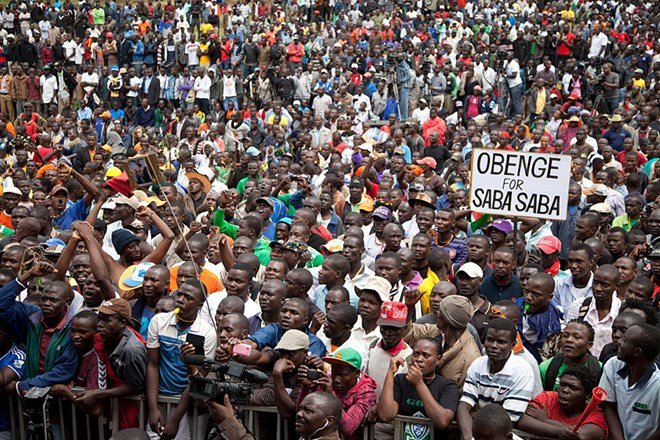
Monday 7,July ,2025 {HMC} Kenya is on edge as the nation marks Saba Saba Day, with mass protests expected nationwide following weeks of public outrage over police brutality, economic hardship, and a controversial protest bill that has drawn widespread criticism.
On the eve of the demonstrations, Nairobi Woman Representative Esther Passaris announced the suspension of the pre-publication process for the Public Order (Amendment) Bill 2025, which seeks to ban protests within 100 meters of state institutions, including Parliament, court buildings, and State House.
“I have decided to pause the pre-publication process… to allow for national dialogue and wide public engagement,” Passaris said Monday, following calls by the National Council of Churches of Kenya (NCCK) to withdraw the bill. She urged Kenyans to uphold “constitutional freedoms while ensuring public order.”
The NCCK praised her decision but also called on security forces to protect the rights of demonstrators. In a statement Sunday, the council condemned Interior Cabinet Secretary Kipchumba Murkomen’s alleged “shoot-to-kill” directive and warned against the use of lethal force.
By early Monday morning, key roads leading into Nairobi’s Central Business District were blocked by anti-riot police. Roadblocks were mounted along Waiyaki Way, Mombasa Road, Thika Road, and other major thoroughfares, leaving thousands stranded. Kenya Railways cancelled overnight trains, and many schools and businesses shut their doors, fearing looting and violence.
The police said no formal protest notice had been received, warning that unauthorized gatherings would be met with firm action under the Protected Areas Act and Penal Code.
In a televised interview, police spokesperson Michael Muchiri reiterated that “while Article 37 guarantees the right to peaceful protest, any violent or armed gatherings will be treated as criminal offences.”
The protests have been fueled by mounting public anger over the recent death of Albert Ojwang, a 31-year-old blogger who died in police custody in early June. His funeral in Kakoth Village on Friday drew thousands of mourners. An autopsy revealed injuries consistent with torture, contradicting initial police claims of self-harm.
Ojwang’s widow, Nevnina Omondi, spoke of his final words — “I love you” and “See you soon” — before he was taken away. His death triggered outrage across the country and further exposed the deep mistrust of police.
“This is not just about Albert,” said activist Odhiambo Ojiro at the funeral. “It’s about every young person who risks arrest or death for speaking out.”
Kenya’s Office of the Director of Public Prosecutions has charged six people, including three police officers, in connection with his murder.
Trade Cabinet Secretary Lee Kinyanjui warned that repeated protests could jeopardize Kenya’s investment climate.
“While the right to protest is enshrined in the Constitution, violence and destruction of property undermine that very freedom,” he said Sunday, cautioning that protests risk “turning Kenya into an unstable environment for investors.”
Some traders in Nairobi’s OTC area — which suffered heavy looting during protests on June 25 — said they planned to close shops and reinforce premises with metal grills and welded bars. Others moved inventory to their homes, fearing another wave of destruction.
President William Ruto faces rising public dissatisfaction over police brutality and a stagnating economy. His administration is accused of betraying campaign promises to support the working class. Protesters have dubbed him “Zakayo,” a reference to the biblical tax collector, amid claims of elitism and corruption.
Calls for Ruto to resign have become more vocal under the slogan “wantam” — or “one term.” Protesters say the president has co-opted the opposition, crushed dissent, and weaponized security forces.
Ruto defended his administration during a recent speech, warning: “If there’s no country for William Ruto, there’s no country for you.”
Saba Saba Day, observed annually on July 7, commemorates the pro-democracy protests of 1990 that forced Kenya to abandon one-party rule under former President Daniel arap Moi. This year’s protests, largely driven by Kenya’s youth, echo the same demands for accountability, justice, and systemic reform.
“Kenya today feels more fragile than it did three years ago,” said Declan Galvin, an analyst with Exigent Risk Advisory. “The young are politically aware and increasingly fearless.”
Source Hiiraan online
