


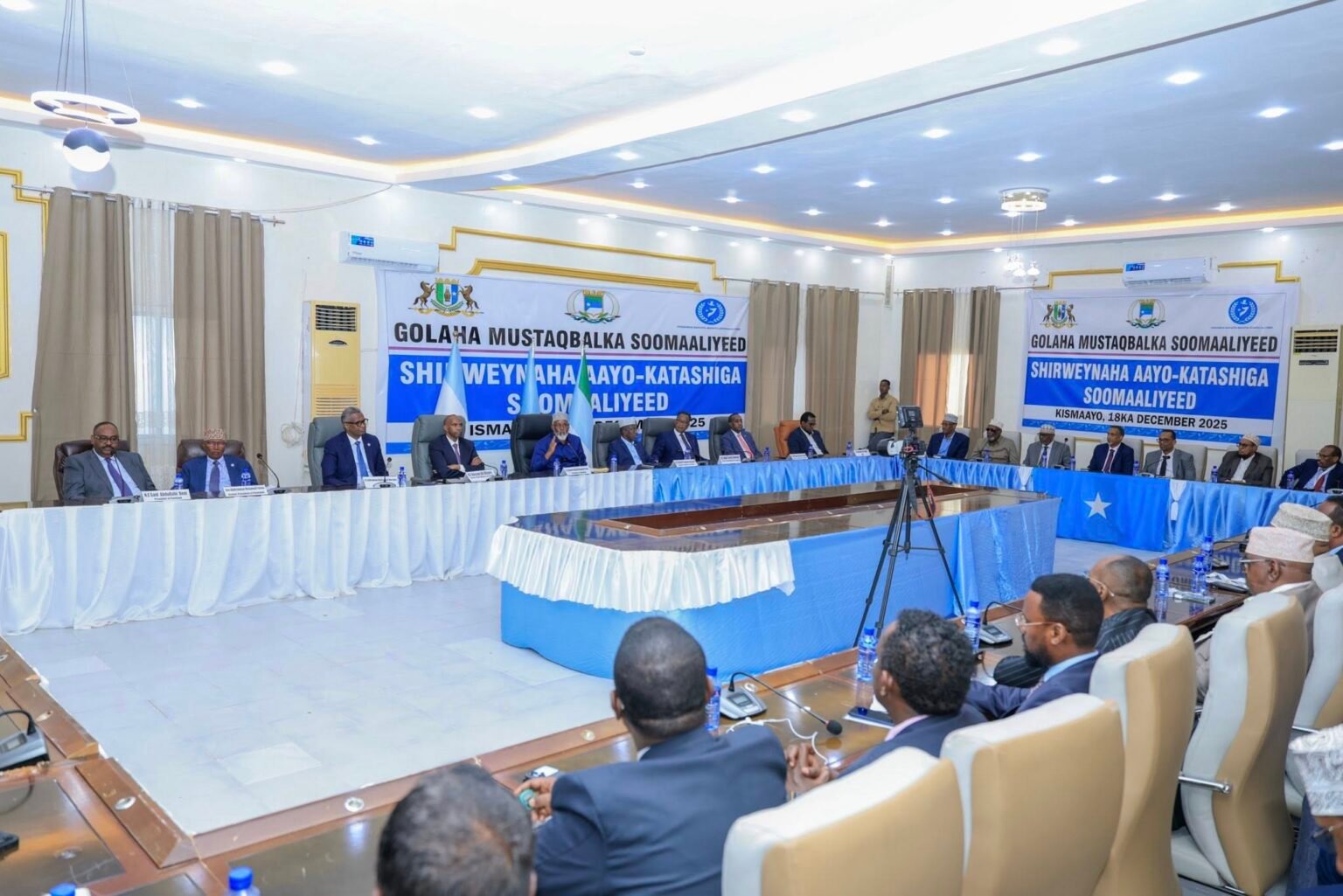
Friday 19 December , 2025 (HMC) Somali Future Council conference opened in Kismayo on Thursday afternoon to discuss political developments and the ongoing election process in the country.
The gathering is attended by prominent political figures, including Puntland President Said Abdullahi Deni, Jubaland President Ahmed Mohamed Islam (Ahmed Madobe), former Somali President Sheikh Sharif Sheikh Ahmed, former Prime Ministers Mohamed Hussein Rooble, Hassan Ali Khayre, and Abdi Farah Shirdoon (Saacid), as well as former minister Abdirahman Abdishakur Warsame.
advertisements
More than 700 delegates arrived in Kismayo in recent days, as the interim capital of Jubaland demonstrated its capacity to host large political gatherings amid tightened security measures.
In his opening remarks, Jubaland President Ahmed Mohamed Islam said Somalis are expecting the conference to produce constructive outcomes that will steer the country toward a consensus-based electoral model and help avert political conflict.
“The importance of this conference is that Somalia is not dependent on the will of one person,” he said.
“Advice must be placed on the table, the remaining time for elections must be clearly understood, and an agreed election process must be reached.”
Puntland President Said Abdullahi Deni said Puntland is ready to play a role in rebuilding the Somali state and urged the federal government to listen to opposition voices.
“If we do not listen to each other and do not respect one another, nothing good will come from it,” Deni said.
“The president and the federal government must allow Somalis to reach a shared view on an election based on agreement.”
Former President Sheikh Sharif Sheikh Ahmed criticized the current electoral environment, saying it risks eroding public trust.
“It is unfortunate that elections that should have been a source of pride have been distorted,” he said.
“People are being forced to register, which distances citizens from the government and undermines the recovery the Somali people have made. We want something meaningful to come out of this conference something the people will welcome.”
Meanwhile, State Minister of the Presidency of Puntland, Abdifatah Abdinur, said the conference aims to consolidate political momentum and prevent what he described as political chaos created by current federal leadership. He urged civil society to support a consensus-driven political process.
Responding to the Kismayo conference, Federal Minister of Interior Ali Yusuf Ali Hoosh said the government does not oppose the meeting, stressing that freedom of assembly is guaranteed under the constitution.
“The Federal Government of Somalia fully respects the constitutional right to assembly and meetings,” Hoosh said.
“This is a right of every Somali citizen and is different from what occurred in the past.”
However, the minister accused opposition figures of resisting the return of power to the people through one-person, one-vote elections, particularly at the local council level.
The Somali Future Council, formed in October, brings together the leaders of Puntland and Jubaland along with members of the Somali Salvation Forum. The alliance seeks to coordinate positions on political and security issues, including preparations for the 2026 elections. The group has rejected moving forward with elections without a broad national consensus.
The Kismayo conference coincides with plans by the National Independent Electoral Commission to hold one-person, one-vote local council elections in Benadir region on December 25, 2025. While preparations are underway in Mogadishu, the Somali Future Council has boycotted the process, accusing the federal government of unilaterally managing elections, amending the constitution without consensus, and violating the federal consultative framework between the federal government and member states.
At the heart of the dispute are the election model, timing, security conditions, constitutional amendments, and the management of the electoral process. While opposition leaders say they support one-person, one-vote elections in principle, they argue that current conditions risk instability and post-election conflict.
Political analysts warn that proceeding with elections without the participation of major political stakeholders could create new political dynamics and deepen divisions, emphasizing that a consensus-based electoral framework remains the most viable path to preventing post-election unrest in Somalia.
Source Hiiraan Online
