


Thursday 25, Dec 2025 {HMC} Somali President Hassan Sheikh Mohamud has pledged to hold open dialogue with opposition leaders to address concerns over the country’s electoral process, saying that “all doors are open” for dialogue and national reconciliation.
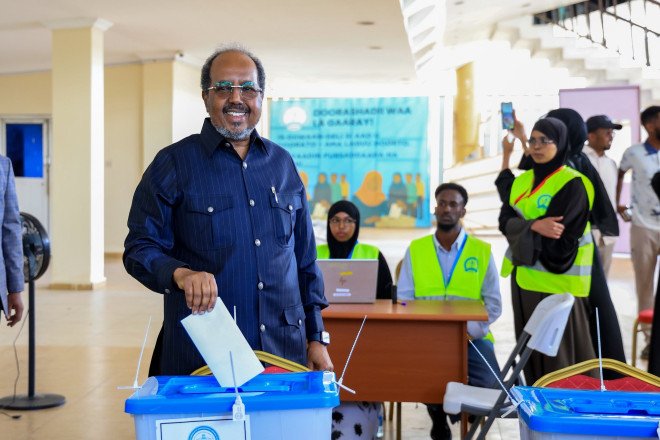
Speaking to the media on Thursday after casting his vote in the Banadir Regional Council elections, President Mohamud described the polls as a significant milestone in Somalia’s long journey toward democratic governance. He said the elections reflect political maturity and the implementation of constitutional principles.
advertisements
“Today’s elections are a historic moment,” the president said, noting that the introduction of the one-person, one-vote system marks a major departure from decades of indirect elections.
He emphasized that inclusive dialogue remains essential for building trust and national unity, and acknowledged concerns raised by opposition politicians regarding electoral reforms and implementation.
“The government is committed to consultation, transparency, and a peaceful political process,” he said, calling on all political actors to prioritize national interests and democratic stability.
President Mohamud commended Mogadishu residents for participating in the vote despite tight security measures and a citywide lockdown imposed to ensure election security. He also praised security agencies and electoral authorities for facilitating what he described as a peaceful voting process.
Prime Minister Hamza Abdi Barre was also among senior officials who cast their ballots on Thursday. He visited several districts where voting was underway, commending election officials and security forces for their efforts.
Traffic across Mogadishu was largely restricted throughout the day, including at Aden Adde International Airport, where all flights were suspended as part of security measures.
The Banadir Regional Council elections mark the first one-person, one-vote polls held in Mogadishu in more than 50 years, electing local councils across the capital’s 16 districts.
Somalia last held direct elections in 1969—excluding votes in the semi-autonomous Puntland region and the breakaway Somaliland—months before the military coup led by Mohamed Siad Barre. Following the collapse of his regime in 1991 and years of civil war, Somalia adopted an indirect electoral system in 2004 to manage clan rivalries and ongoing insecurity.
Critics, however, argue that indirect elections have fostered corruption, while opposition parties say the rapid rollout of the new voting system could favor President Mohamud’s re-election prospects.
Opposition leaders have also raised concerns about whether security conditions are sufficient for mass voting, citing continued attacks by al Qaeda-linked al Shabaab, which still controls large rural areas and frequently targets major population centers.
Despite those concerns, the Mogadishu vote held in a city of approximately three million people is widely viewed as a test case for the possible expansion of direct elections at the national level.
Source Hiiraan online
