


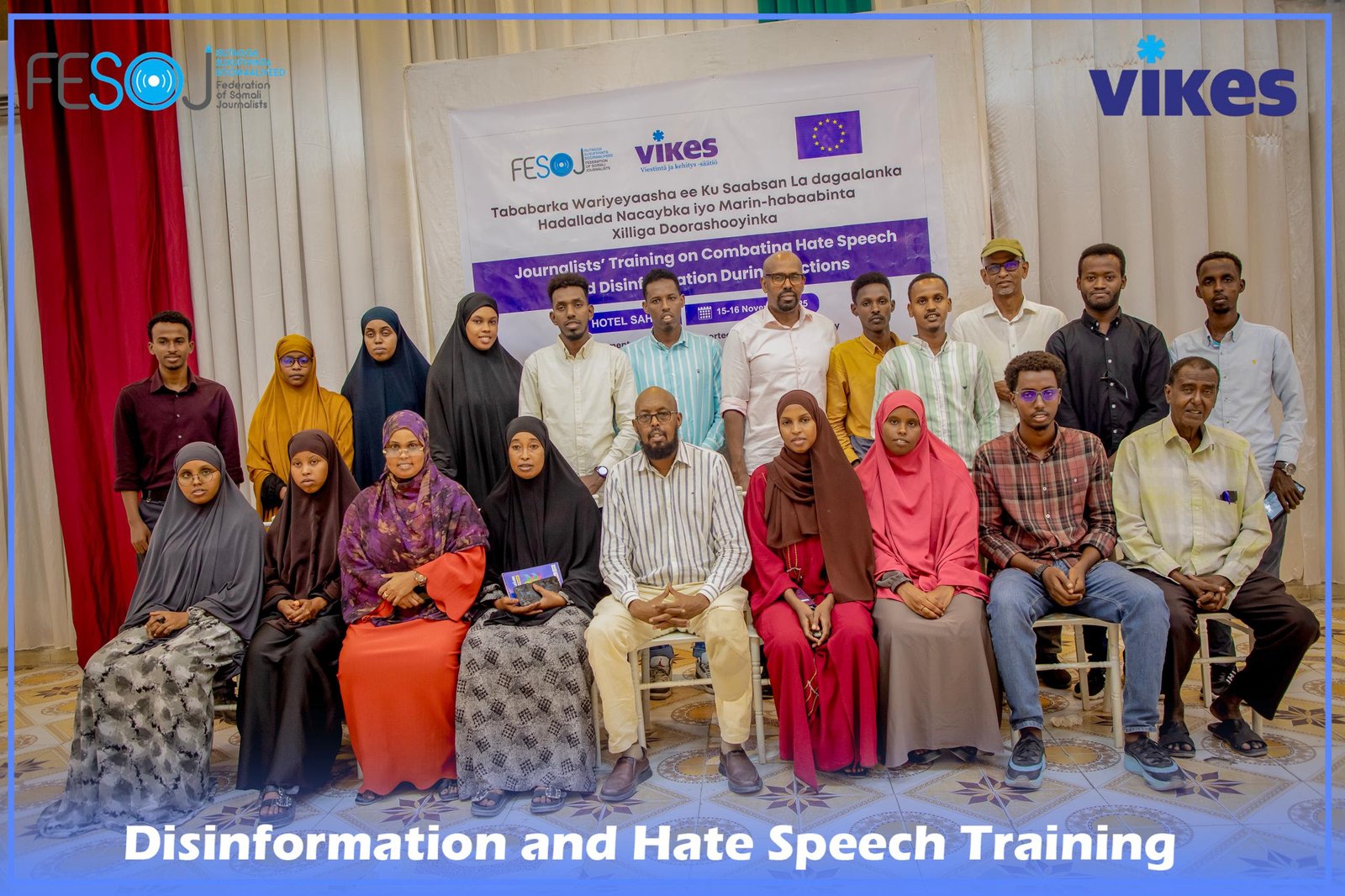
Monday, 24, Nov 2025 {HMC} With the support from the EU and in partnership with VIKES, the Federation of Somali Journalists (FESOJ) has completed a two-day training for twenty journalists on combating hate speech and disinformation during elections in Mogadishu, Somalia.
Twenty persons participating the training were from Radio Mogadishu, Radio Hiran Weyn, Radio Hilow, SNTV, Rays TV, Banadir Regional TV, Himilo TV, Asal TV, freelancers, Somali Women Journalists Rights Association (SOWJRA), Hamar Newspaper, the Capital Voice Website and Faculty of Journalism, Somali National University.
The capacity building program on combating hate speech and disinformation which is often spread during elections have been in progress from the 15th to 16th November 2025 at Sahafi Hotel in Mogadishu city, Somalia.
Leading trainers from FESOJ and VIKES has facilitated presentations and video clips centering on main topics including: misinformation, disinformation, fake news and propaganda.
“The aim of the training is to empower journalists and media professionals with the skills and knowledge needed to identify, prevent, and responsibly report hate speech and false information, and to promote accurate, fair, and peaceful election coverage that supports public trust and social cohesion.”.” Farah Omar Nur, Secretary General of FESOJ has stated in his opening remarks.
“Disinformation on social media in Somalia is fueled by low media literacy, political and conflict-driven manipulation, limited fact-checking capacity, and the rapid spread of hate and clan-based narratives on widely used but weakly regulated platforms.” On his part, Wali Hashi, VIKES Somali Program Coordinator pointed out.
Wali Hashi emphasized that disinformation and hate speech are global issues. However, in the Somali context, the groups that suffer the most from hate speech are women, particularly female journalists and women working in the legal profession. They are constantly subjected to intimidation and blackmail. Hate speech targeting women is especially difficult to address due to cultural challenges. Women generally do not feel confident speaking out about the hate speech directed at them.
Furthermore, Yusuf Mohamed Mubarak, a Communication Expert and guest speaker from Finland, emphasized that we are living in a digital age that presents serious challenges related to disinformation, fake news, and misinformation, which can potentially lead to security disruptions and even economic collapse. He stressed the importance of preventing such risks, particularly during elections, by ensuring that news shared with the public is accurate, relevant, and based on verified facts.
Mohamed Mohamud Cade presented the trainees with videos illustrating numerous examples of how disinformation can spread and how journalistic content can be manipulated. He highlighted a case involving a 2012 speech by Somali President Hassan Sheikh Mohamud, which some journalists had misleadingly republished as if it were from 2025. The example provided by Mohamed was highly eye opening for the trainees.
Mr. Ahmed Ali Mohamed, Head of FESOJ’s Training Department has encouraged the participants for their active participation in the training sessions on hate speech and disinformation during the elections.
During the two- day training proceedings, the participants have been taken through themes on what is the difference between misinformation, disinformation, fake news and propaganda. Furthermore, the main topics covered included the social affects of fake news, what problem can it cause, steps to combat disinformation (fake news) and how hate speech can influence Somali elections.
In addition, the participants were provided with opportunity for group discussion session on: What is fake news and how does it differ from misinformation and disinformation? How does fake news affect public opinion and behavior in Somali Context? and Ethically, what is role of government and Media in regulating and combating fake news.?
A short clip on hate speech was presented for open discussion, during which participants emphasized the importance of combating the spread of hateful content. This was followed by a presentation of past political video by the politician on the one-person, one-vote elections, highlighting the critical role of fact-checking.
The participating journalists were advised to refrain from disseminating unsourced or unverified information and to ensure that all news shared with the public is based on credible and reliable sources.
Thereafter, as session on spotting misinformation and A.I generated photos was presented and the need to provide journalists with tools for verifying images.
Naima Hassan Ali, a female reporter from Radio Mogadishu, stated that the two-day training focused on hate speech and disinformation spread through social media while emphasizing the media’s role in prevention. She explained to have learned how fake videos and photos circulate, how to curb hate speech during elections to prevent fear and displacement, and how to identify AI-generated content falsely attributed to individuals. She appreciated the facilitators and expected journalists to apply the skills gained in their work.
“The main themes we learned from the training conducted by FESOJ with the support of VIKES included combating hate speech and misleading information during elections, as well as understanding the differences between misinformation, disinformation, fake news, and propaganda, which are widely spread on social media during election periods,” said Mohamed Deeq Yusuf Moalim, journalist from Banadir TV. “As journalists, we expect to apply these skills in our work and ensure we deliver reliable and accurate news to the public as the country enters the election period.”
In his closing remarks, Farah Omar Nur, FESOJ Secretary General appreciated the participants for their time in attending the workshop. He mentioned hate speech and misuse of information can lead to conflict and political instability, but stressed for the need to be checked to prevent disinformation and strengthen peace.

