



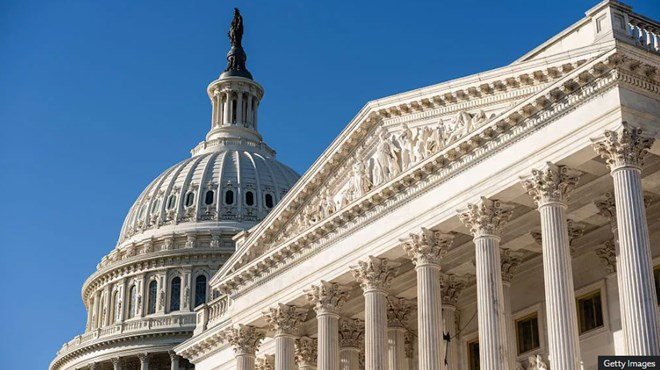
Wednesday November 12, 2025 {HMC} A deal to reopen the US government has cleared the Senate, bringing the budget stand-off between Republicans and Democrats in Congress closer to an end.
It needs to be approved in the House of Representatives before the current shutdown – the longest on record – will officially be over.
Until then, many – but not all – US government services will still be temporarily suspended, and around 1.4 million federal employees will remain on unpaid leave or continue working without pay.
When will the US government shutdown end?
A new funding bill finally passed the Senate 60-40 on 10 November, after seven Democrats and one independent sided with Republicans to approve the measure.
But it will still take days to reopen the government, even if the budget swiftly clears the House of Representatives and is signed into law by President Donald Trump.
The deal only extends money for the federal government until 30 January, but would fund food aid under the Supplemental Nutrition Assistance Program (SNAP) until September 2026.
It guarantees that all federal workers will receive back-pay, and reverses the shutdown-related layoffs of thousands of federal workers.
“I’ll abide by the deal,” Trump said.
Democrats will get a vote in December on extending healthcare subsidies that are due to expire by the end of the year, a key sticking point, although Republicans offered them this weeks ago.
When will the House vote on the budget?
The funding bill now heads to the Republican-controlled House of Representatives.
The party only has a two-seat majority in the lower chamber so the vote is expected to be close.
Most House Republicans are expected to support the funding bill, but House Democrats are expected to oppose it.
Complicating the path forward, House Republicans have not committed to vote on the healthcare subsidy part of the deal, unlike their Senate counterparts.
“I’m not promising anybody anything,” said Republican House Speaker Mike Johnson.
Why did the US government shut down?
In the US system, both chambers of Congress must approve a spending plan to send to the president to be signed into law.
The Republicans currently control both the House of Representatives and the Senate, but at the end of September, they were seven short of the 60 votes needed to pass an earlier spending bill in the Senate.
That gave the Democrats some negotiating leverage. The party’s main demand was that the bill should include an extension of expiring tax credits that make health insurance cheaper for millions of Americans.
The House was able to pass a temporary funding bill to avoid the shutdown, but it could not clear the Senate amid Democratic resistance.
So on 1 October, the US government shut down for the first time in nearly seven years.
Which government services have stopped, and which have carried on?
Thousands of government employees deemed non-essential have been furloughed – temporarily put on unpaid leave.
But not all aspects of government stop during a shutdown.
Federal law enforcement are expected to operate as usual, Social Security and Medicare cheques are still distributed, and mail is delivered. The Trump administration has so far found money to pay the troops.
Air traffic controllers are also expected to work without pay, but some of them have been calling in sick, leading to many flights being cancelled or delayed.
More than 42 million Americans who rely on SNAP food aid benefits have received only partial payments after the Supreme Court allowed the Trump administration to withhold some funding pending further legal hearings.
While most federal employees are not paid during a shutdown, members of Congress do continue to receive their salary.
How has the shutdown affected the economy?
The impact of government shutdowns on the economy is typically limited and temporary – similar to the disruption caused by a hurricane or major storm.
But it still causes problems. Approvals for loans and permits are delayed and hundreds of millions of dollars in federal contracts are suspended.
Unlike government employees, contractors do not receive back pay once a shutdown ends, and many of them are small businesses without other big clients.
Overall, analysts estimate this shutdown will knock roughly 0.1 to 0.2 percentage points off economic growth for each week that it continues – about $15bn a week.
What happened during previous US government shutdowns?
Shutdowns over budgets are a unique aspect of US politics.
The second-longest ever shutdown dragged on for 35 days, beginning in late 2018 during Trump’s first presidential term.
But these legislative standoffs predate the current president.
There were eight shutdowns during the presidency of Ronald Reagan in the 1980s, though all were relatively brief.
Former Democrat President Bill Clinton had a 21-day shutdown in 1995, while his fellow Democrat Barack Obama had a 16-day shutdown in 2013.
Source BBC NEWS
