


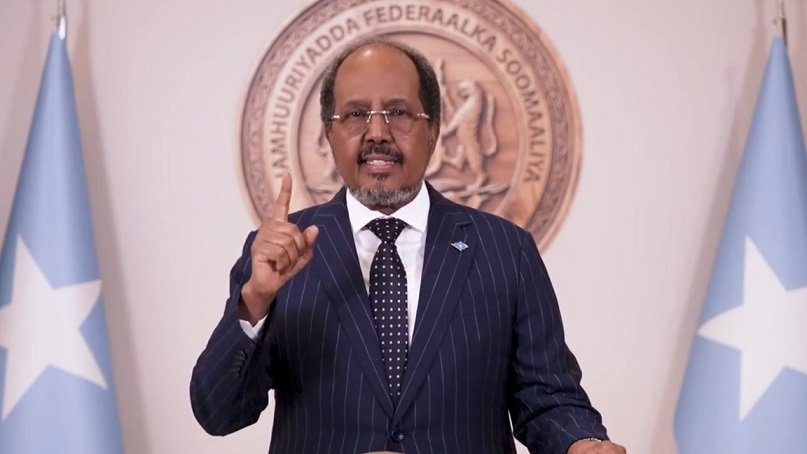
Friday 20, March 2026 {HMC} Somali President Hassan Sheikh Mohamud on Thursday called on business leaders, religious scholars and charitable organizations to step up support for drought-affected families, particularly orphans and other vulnerable groups, as the country faces deepening hunger and rising living costs.
In his Eid address to the nation, the president appealed for solidarity at a time when nearly 6.5 million people in Somalia are projected to face crisis-level or worse food insecurity by the end of March, according to the latest Integrated Food Security Phase Classification (IPC) analysis released by the federal government and U.N. agencies.
Worsening drought, prolonged conflict and cuts in global aid have intensified the humanitarian crisis, leaving millions struggling to access food, water and basic services.
Hassan Sheikh said regional instability, including conflicts in the Middle East, has contributed to rising prices of essential goods in Somalia. He urged that such disputes be resolved through dialogue to prevent further economic shocks that could harm Somali households.
To address domestic price pressures, the president announced the formation of a special committee tasked with monitoring and reducing the cost of essential commodities. The body will include representatives from the ministries of Finance, Planning, Trade and Industry, as well as the Chamber of Commerce, the Office of the Attorney General and the Treasury.
The committee’s mandate, he said, will be to ensure fair pricing and ease the burden on ordinary citizens.
The president also said the government is continuing efforts to strengthen security, expand democratic governance and promote economic development. He reiterated an offer of amnesty to youth affiliated with al-Shabab and ISIS, urging them to abandon violence and reintegrate into society.
Hassan Sheikh further emphasized that political dialogue remains open and is the only path toward lasting solutions and stable governance.
Somalia is navigating a complex moment marked by political tensions, security challenges and mounting humanitarian needs, with aid agencies warning that sustained support will be critical to prevent further deterioration in living conditions.
