



Wednesday 25 Mar 2026 {HMC} The Trump administration has been fast-tracking the legal proceedings of Somali immigrants, effectively denying them the right to a fair hearing and potentially expediting their removal from the United States, two Minnesota-based legal providers alleged in a federal lawsuit on Tuesday.
The lawsuit claims that since late January, the Justice Department has placed Somali nationals on a separate docket and scheduled hearings with little notice, making it difficult for lawyers to represent their clients. The filing was made in the U.S. District Court for the District of Columbia.
Hines Immigration Law, a private firm in Roseville, Minn., and the Advocates for Human Rights, a nonprofit legal services provider based in Minneapolis, asked the court to immediately halt the policy, calling it unconstitutional.
“This is not about efficiency or docket management,” Kelsey Hines, who owns Hines Immigration Law, said in a statement. “This is an undeniably targeted policy that singles out one nationality, designed to rob them of the due process they are legally guaranteed and to strip their legal teams of the ability to adequately and ethically prepare their cases for hearing.”
The Justice Department did not immediately respond to requests for comment.
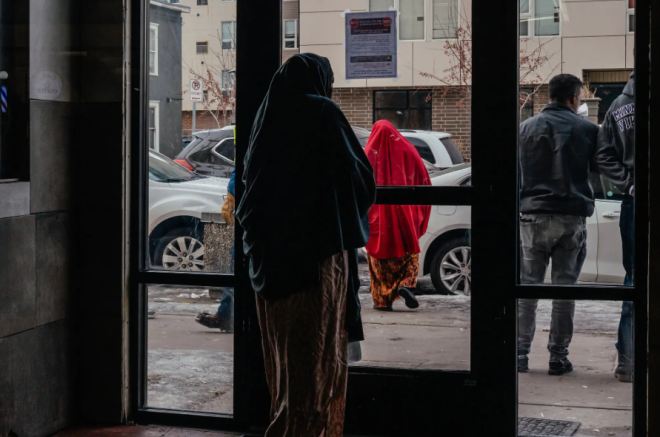
The lawsuit follows a surge in immigration enforcement operations in Minnesota, which is home to 80,000 Somalis, the largest population of the group in the United States. The measures included a targeted effort against Somali nationals, whom President Trump has repeatedly disparaged.
Beginning in December, the Trump administration deployed thousands of federal immigration agents to the Minneapolis area, saying it was targeting fraud, which had implicated a pocket of Minnesota Somalis.
That group has come under considerable fire from Mr. Trump, who in December called Somalis “garbage,” adding that “we don’t want them in our country.” He has repeatedly denigrated Representative Ilhan Omar, a Minnesota Democrat who came to the United States as a refugee from Somalia, with racist attacks.
The administration is also seeking to end deportation protections for more than 2,000 migrants from Somalia who are able to live and work in the United States through a program called Temporary Protected Status. On March 13, a federal judge blocked the administration’s effort to end those protections because the government had not been prepared to defend it in court. The administration has appealed that decision.
In the legal filing Tuesday, the plaintiffs described what they claimed was the new policy against Somalis as an escalation of the administration’s “hateful rhetoric.” The policy has not been confirmed to The New York Times by Trump administration officials, but several immigration lawyers have reported a blitz in hearings scheduled specifically for their Somali clients.
Immigration cases usually take years to resolve and involve multiple hearings, including master calendar hearings that are procedural and individual merits hearings that include testimony and evidence supporting the person’s request for relief. Merits hearings are usually scheduled a year in advance, the filing said, giving lawyers ample time to prepare.
Lately, though, individual hearings for Somalis that were scheduled to take place in late 2026, 2027 or 2028 have been scheduled with as little as one month’s notice, the plaintiffs said. The legal groups also said that the cases had been scheduled with a small set of immigration judges who have higher than average rates of removal.
Ms. Hines said in a statement that 97 percent of her Somali clients’ cases had been rapidly advanced under the policy. Even if she were to work 12-hour days, seven days a week, she said, she would be 7,000 hours short of the time needed to prepare their cases.
The legal filing states that of the 3.3 million pending cases in immigration court, roughly 3,200 involve Somali nationals, according to the latest data from the Transactional Records Access Clearinghouse, a data collection center at Syracuse University.
Pooja Salhotra covers breaking news across the United States.
