


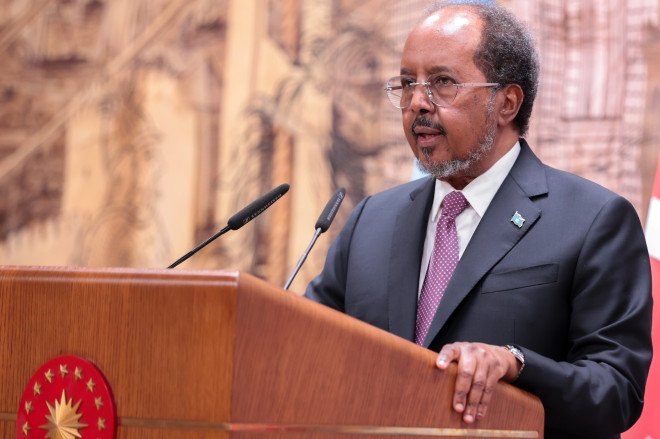
Friday 9 Jun 2026 {HMC} Somali President Hassan Sheikh Mohamud on Thursday night forcefully rejected Israel’s recognition of Somaliland, warning that the move threatens Somalia’s unity and regional stability, while renewing his call for dialogue with Somaliland’s leadership to resolve decades-old political grievances.
In a nationally broadcast speech posted by the presidential palace, Hassan Sheikh said Somalia would not accept any attempt to divide the country through unilateral foreign action, describing Israel’s decision as driven by its own strategic interests rather than the welfare of Somaliland’s population.
advertisements
“The Federal Republic of Somalia is one country, free and indivisible,” the president said. “Its territory cannot be divided by a document written by Israel or signed by Benjamin Netanyahu,” whom he described as facing international legal challenges.
Hassan Sheikh said the federal government, working with international partners, was taking measures to block what he called Israeli violations of Somalia’s sovereignty, and he thanked foreign governments and organizations that have publicly backed Somalia’s territorial integrity.
The speech marked the president’s second direct address on Israel’s recognition of Somaliland, announced late last year and widely condemned by regional and international bodies, including the African Union, Arab League, European Union, IGAD and the Organization of Islamic Cooperation.
Much of the speech focused on Somalia’s fraught relationship with Somaliland, which declared independence in 1991 but has never received international recognition.
Hassan Sheikh said successive Somaliland administrations had failed to fully engage in dialogue with Mogadishu, arguing that talks had stalled largely on the Hargeisa side.
“Unfortunately, successive administrations in Somaliland did not dare to recognize that dialogue is the solution to achieving unity,” he said, adding that alternative paths had only deepened divisions among Somalis.
He cited the now-suspended memorandum of understanding between Somaliland and Ethiopia as an example of what he described as a unilateral move that derailed earlier optimism about negotiations.
The president stressed that Somalia’s federal government has consistently pushed for talks, saying he personally prioritized dialogue during both his previous and current terms in office and warned against inflammatory rhetoric that revives memories of past conflict.
Hassan Sheikh argued that Israel’s recognition was not about Somaliland’s aspirations but about broader geopolitical ambitions, including what he alleged were plans to establish military bases and advance Israeli interests across the Horn of Africa, the Red Sea and the Gulf of Aden.
He warned that, if mishandled, the situation could negatively affect Somalia’s economy, development and political stability.
Somaliland authorities have denied claims that recognition would allow Israeli military bases or facilitate the resettlement of Palestinians from Gaza. Israeli officials have promoted what they describe as voluntary Palestinian migration, a proposal strongly rejected by Arab states and international organizations.
Addressing Somaliland’s leadership directly, Hassan Sheikh said international recognition cannot occur without the consent of the parent state, citing examples such as South Sudan and Eritrea, whose independence followed negotiated political agreements.
“If the original country is not convinced, recognition is not possible,” he said, comparing Somaliland’s situation to Catalonia in Spain and Taiwan in China, regions that lack broad international recognition due to unresolved sovereignty disputes.
“Recognition is not in Netanyahu’s hands,” Hassan Sheikh said. “It lies with the government and people of Somalia.”
Despite his firm tone, the president said the federal government remained open to compromise, emphasizing that unity could be achieved through meaningful concessions.
“If it is recognition of rights, decentralization, power-sharing we are ready for it,” he said. “We are ready for real dialogue and mutual understanding.”
Hassan Sheikh acknowledged the suffering endured by civilians in northern Somalia under past military regimes, saying Mogadishu had already recognized those injustices and that dialogue remained the only path to addressing historical wrongs.
In recent days, more than 20 countries issued a joint statement condemning Israel’s recognition of Somaliland and urging Tel Aviv to reverse its decision. Signatories included Saudi Arabia, Egypt, Türkiye, Nigeria, Pakistan, Qatar and Somalia, with endorsement from the Organization of Islamic Cooperation.
The president said the breadth of international opposition reinforced Somalia’s position and underscored global support for its sovereignty.
As diplomatic pressure mounts, Hassan Sheikh framed the moment as a test of unity, urging Somalis to reject division and warning that foreign recognition without Somali consent would neither bring stability nor legitimacy.
Source Hiiraan Online
