


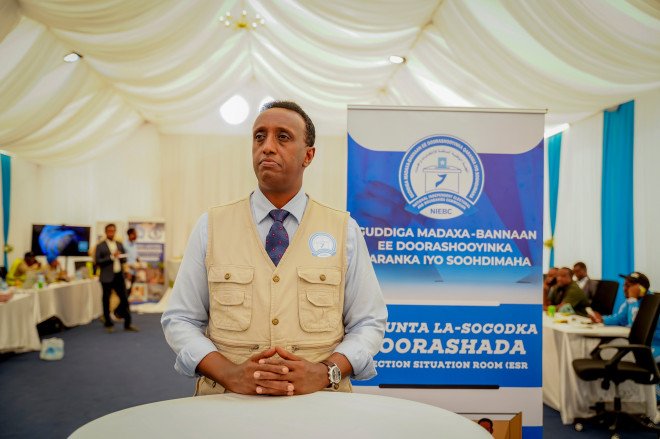
Friday 26 Dec , 2025 {HMC} Somalia’s National Independent Electoral and Boundaries Commission (NIEBC) has announced the start of the vote-counting process following the conclusion of voting in the Banadir Regional Council elections on Thursday evening.
Speaking to national media shortly after polls closed, NIEBC Chairperson Abdikarim Ahmed Hassan said voting began at 6:00 a.m. and officially ended at 6:00 p.m., describing the process as calm, orderly, and well-organized across Mogadishu’s districts.
advertisements
“The voting process concluded peacefully this evening, and the counting of ballots will now begin,” Abdikarim said. “Observers, representatives of political organizations, civil society groups, and members of the international community will be present throughout the counting process.”
He noted that voter turnout was strong, with participation from all segments of society, including elders, youth, women, and political leaders, who cast their ballots smoothly throughout the day.
The chairperson emphasized that the Electoral Commission is committed to transparency and will provide regular updates to the public as the vote-counting progresses. He added that the process is expected to take a relatively short period of time.
In his remarks, Abdikarim expressed appreciation to the Somali Police Force for maintaining security, as well as election workers, national and independent media, voters, and all stakeholders who contributed to what he described as a successful and credible election.
Approximately 1,605 candidates are contesting 390 seats across Mogadishu’s district councils. Once elected, council members will select the mayor of Mogadishu.
The Banadir Regional Council elections mark the first one-person, one-vote polls held in Mogadishu in more than 50 years, covering all 16 districts of the capital.
Somalia last held direct elections in 1969 excluding the semi-autonomous Puntland region and the breakaway Somaliland months before the military coup led by Mohamed Siad Barre. Following the collapse of his regime in 1991 and years of civil war, the country adopted an indirect electoral system in 2004 to manage clan divisions amid ongoing insecurity.
The Mogadishu vote is widely viewed as a key test for the possible expansion of direct elections at the national level.
SOurce Hiiraan Online
