Jimco 31 Jan , 2025 {HMC} Duqa mucaaradka ka tirsan ee magaalada Istanbul, Ekrem Imamoglu, ayaa Jimcaha maanta ah si adag u cambaareeyay waxa uu ugu yeeray “cadaadis dhanka garsoorka ah” oo lagu hayo, iyadoo kumanaan taageerayaashiisa ah ay caddaalad ka dalbanayeen maxkamadda horteeda.
Imamoglu, oo ah ninka ugu weyn ee Madaxweyne Recep Tayyip Erdogan kaga soo horjeeda dhinaca siyaasadda, ayaa hadalkan jeediyay kaddib markii uu warbixin siiyay xeer ilaalinta, taasoo la xiriirtay laba baaritaan oo lagu furay horraantii bishan.
Waxa uu sidoo kale wajahayaa dhowr dacwadood oo kale oo sharci ah.
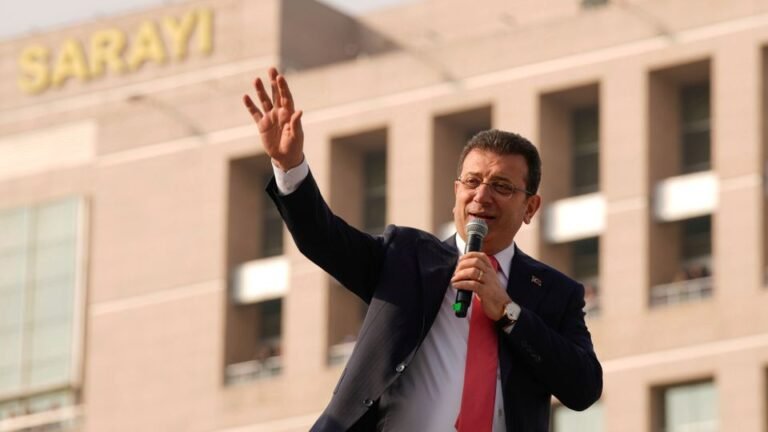
“Waxaan la kulmeynaa cadaadiskii garsoor ee ugu darnaa ee ka jira Istanbul,” ayuu u sheegay taageerayaashiisii isku soo baxay, isagoo dul taagan saqafka sare ee bas, kaddib markii uu ka soo baxay maxkamadda Caglayan ee Istanbul.
Imamoglu, oo ka tirsan xisbiga ugu weyn mucaaradka ee CHP, isla markaana dib loogu doortay duqa magaalada sannadkii hore, ayaa ballan qaaday inuusan marnaba is dhiibi doonin. “Waan sii wadi doonnaa la dagaallanka dulmiga iyo caddaalad-darrada,” ayuu yiri.
Bayaankiisa Jimcihii wuxuu daba socday laba baaritaan oo lagu hayo hadallo uu ka sheegay xeer ilaaliyaha guud ee Istanbul iyo markhaati khabiir ah oo ay maxkamaddu magacawday, kaasoo qayb ka ahaa dacwado ka dhan ah golayaasha deegaanka ee CHP ay maamusho.
Waxaa loo haystaa inuu geystay hanjabaad, aflagaado, iyo bartilmaameedsi sarkaal, iyo waliba isku day ah inuu saameyn ku yeesho maxkamadeyn caddaalad ah.
Qoraal uu u gudbiyay xeer ilaaliyaha, oo nuqul ka mid ah ay aragtay wakaaladda wararka ee AFP, ayuu Imamoglu ku beeniyay dhammaan eedeymaha loo soo jeediyay, isagoo xusay inuu si xor ah u adeegsanayay xorriyatul qawlka.
“Ma jirin wax hanjabaad ah ama bartilmaameedsi ah oo ku jiray hadalladeyda. Waxa aan sheegay uun waxay ahaayeen fikirkeyga xorta ah,” ayuu yiri. “Xorriyatul qawlku waa xuquuq dastuuri ah, taasoo ay ka mid tahay in xaq loo yeesho dhaleeceynta hay’adaha garsoorka iyo hab-shaqeedkooda,” ayuu hadalkiisa raaciyay.
‘Shirqool’
Isagoo la hadlayay taageerayaashiisii aadka u tirada badnaa, Imamoglu wuxuu shaaca ka qaaday in “shirqool” la maleegay.
Dhanka kale, Duqa mucaaradka ee Ankara, Mansur Yavas, oo isna goobta joogay si uu u taageero, ayaa ku eedeeyay dowladda Turkiga inay dalka u beddeshay “xabsi weyn oo furan.”
Mas’uuliyiinta Turkiga ayaa si joogta ah u beegsada suxufiyiinta, qareennada iyo wakiillada siyaasadeed ee la soo doorto, gaar ahaan tan iyo afgambigii dhicisoobay ee 2016-kii.
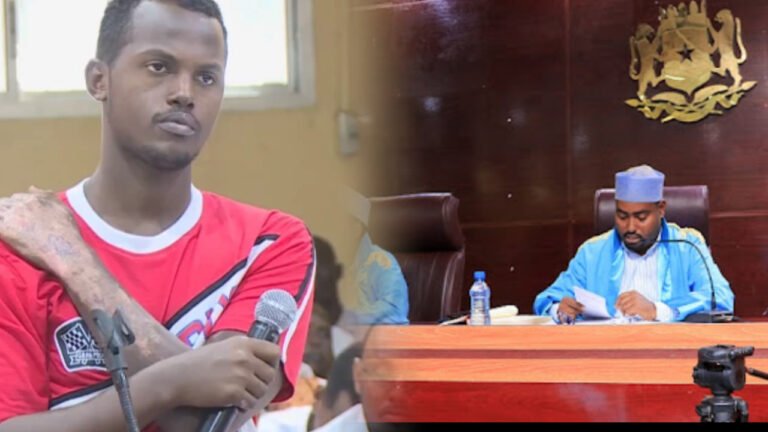
Tusaale ahaan, Maxkamad ku taalla Istanbul ayaa Khamiistii amartay in la soo xiro wariye ka tirsan telefishin mucaarad ah, kaddib markii uu baahiyay wareysi ay mas’uuliyiintu sheegeen in lala yeeshay qofka wareysiga bixiyay, iyadoo uusan oggolaansho ka haysan – qofkaas oo ahaa isla khabiirkii ay maxkamaddu magacawday ee Imamoglu dhaleeceeyay.
Dadkii isugu soo baxay waxaa ka mid ahaa taageerayaal qaar oo xirnaa maaskaro ay ku sawiran tahay wejiga Imamoglu, halka kuwa kalena ay lulayeen boorar. Goobta waxaa ka muuqday ciidan boolis ah oo aad u tiro badan.
“Dowladda waxay isku dayaysaa inay ciriiriso fursadaha ay haystaan mucaaradka, oo ay ku jiraan suxufiyiinta, ayna ku cabsi geliso eedeymo aan sal iyo raad toona lahayn,” ayuu yiri Fethi Kocaer, oo 71 jir ah, kaasoo haystay boor ay ku qoran tahay: “Si wadajir ah ayaan u halgami doonnaa.”
“Geesinimada iyo mowqifka adag ee Duqa Imamoglu ayaa naga caawin doona inaan midowno. Ma quusaneyno, balse waxaan sii xoojin doonnaa la dagaallanka dulmiga,” ayuu u sheegay wakaaladda wararka ee AFP.
Fevziye Yalcin, oo 57 jir ah, ayaa iyaduna sheegtay in dacwadaha ka dhanka ah Imamoglu ay yihiin kuwo aan wax macno ah samaynayn.
“Arrintaasi waxay kaliya naga dhigaysaa kuwo kasii xoog badan rabitaankeenna ah inaan la dagaalanno iyaga. Ugu dambayntii, waxaan kula xisaabtami doonnaa dowladda goobaha codbixinta,” ayay si geesinimo leh u tiri.
Jimco 31 Jan , 2025 {HMC} Ciidamada Maraykanka ayaa sheegay in ay dileen sarkaal sare oo ka tirsan garabka Al-Qaacida ee Suuriya kadib duqayn xagga cirka ah oo Khamiistii ka dhacday waqooyi-galbeed dalka Suuriya.
Deegaankaasi ayaa ahaa goob ay si wayn ugu xoogganayd kooxda Hay’at Tahrir al-Sham (HTS) ee uu hoggaamiyo madaxweynaha ku-meel-gaarka ah Axmed al-Sharaa ka hor intii aysan hoggaamin gulufkii fallaagada ee xukunka ka tuuray Bashaar al-Asad bishii Diseembar ee sanadkii tegey.
“Ciidamada Taliska Dhexe ee Maraykanka (CENTCOM) ayaa fuliyay duqayn cirka ah oo bartilmaameedkeedu ahaa mid qeexan oo ka dhacday waqooyi-galbeed Suuriya, iyagoo beegsaday oo dilay Maxamed Saalax al-Zabir, oo ahaa sarkaal sare oo ka tirsan ururka argagixisada ee Xurraas al-Diin, oo xiriir la leh Al-Qaacida,” ayaa lagu yiri bayaan kasoo baxay CENTCOM.
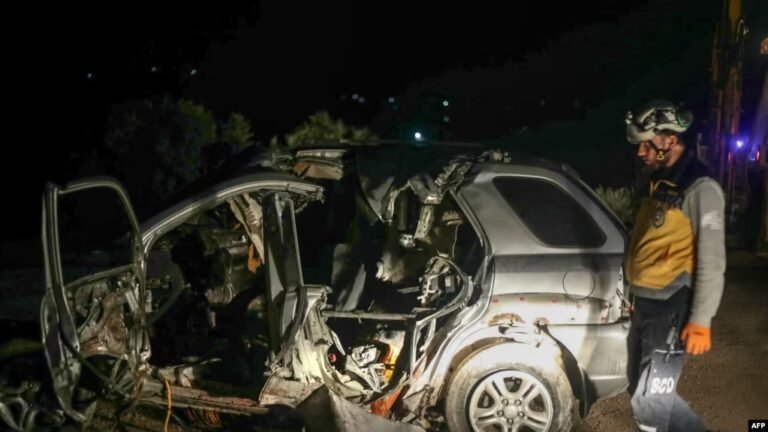
Hay’adda la socodka dagaallada ee fadhigeedu yahay dalka Britain ee loo yaqaan Syrian Observatory for Human Rights ayaa sheegtay in Zabir uu ku geeriyooday markii gaari uu la socday oo marayay wadada isku xirta Sarmada iyo Idlib ay gantaal ku dhufatay diyaarad aan duuliye lahayn (Drone) oo Maraykanku leeyahay.
Duqaynta Maraykanka ayaa timid maalmo uun kadib markii Xurraas al-Diin ay shaaciyeen inay is-kala direen, iyagoo fulinaya amarro uga yimid madaxweynaha ku-meel-gaarka ah.
Hay’adda Observatory ayaa sheegtay in Xurraas al-Diin “ay ku dhawaaqeen inay is-kala direen si aysan ugu lug yeelan isku dhac hubeysan oo ay la galaan HTS.”
Jabhaddii Sharaa ayaa ahayd garabkii Al-Qaacida u qaabilsanaa Suuriya illaa ay xiriirka u jartay shabakadda jihaad-doonka ah sannadkii 2016-kii.
Hay’adda SITE Intelligence Group ee fadhigeedu yahay Maraykanka ayaa sheegtay in Xurraas al-Diin la aasaasay bishii Febraayo 2018-kii.
Si rasmi ah uma aysan xaqiijin daacadnimadeeda Al-Qaacida illaa ay ku dhawaaqday is-kala diriddeeda Talaadadii lasoo dhaafay.
Maraykanka ayaa Xurraas al-Diin u aqoonsaday “urur argagixiso” sannadkii 2019-kii, wuxuuna ballan-qaaday abaalmarinno lacageed oo lagu soo sheego macluumaadka xubno dhowr ah oo ka tirsan.
Waxay fulisay duqaymo xagga cirka ah oo is-daba-joog ah oo lagu beegsanayay hoggaanka kooxdaasi ee waqooyi-galbeed Suuriya bishii Agoosto iyo Sebtembar ee sannadkii tegey.
Washington ayaa weli liiska madow ku haysa HTS, iyadoo u aqoonsan “koox argagixiso ah”, inkastoo ay qaar ka mid ah cunaqabatayntii ka qaadday kooxda Sharaa tan iyo markii ay xukunka ka tuureen Asad sannadkii hore.
Friday 31 Jan , 2025 {HMC} The Commissioner of the Somali Disaster Management Agency, Mahmoud Ma’alin Abdulle, and his delegation have concluded a successful humanitarian mission to Russia.
A farewell ceremony was held by the Deputy Minister of the Ministry of Civil Protection, Emergencies and Disaster Management of the Russian Federation, Mr. Kurynin Roman Viktorovich, and the Governor of the Arkhangelsk Region, Mr. Alexey Alsufev, following important discussions between the two parties.
During the ceremony, Mr. Mahmoud Ma’alin Abdulle expressed his gratitude for the warm welcome, hospitality, and high-level farewell accorded to the Somali delegation. He emphasized the importance of continued close cooperation between the two governments in areas of humanitarian activities, technical support, and disaster management.
Minister Kurynin Roman Viktorovich and Chairman Alexey Alsufev reiterated Russia’s commitment to supporting the Somali people through humanitarian assistance and the development of various projects aimed at improving the country’s infrastructure and overall wellbeing.
The visit marks a significant step towards strengthening the ties between Somalia and Russia, with both sides expressing optimism for future collaborations.
Friday 31 Jan , 2025 {HMC} Rwanda-backed rebels who captured eastern Congo’s largest city said Thursday they want to take their fight to the far-off capital, Kinshasa, while Congo’s president called for a massive military mobilization to resist the rebellion and his defense minister rejected calls for talks.
In a video message, Congo’s Defense Minister Guy Kabombo Muadiamvita said he has directed plans for any dialogue with the rebels to “be completely burned immediately.”
“We will stay here in Congo and fight. If we do not stay alive here, let’s stay dead here,” said Muadiamvita, a close ally of Congo’s president.
At a briefing where they sought to assert their control over the eastern city of Goma and surrounding territory in the neighboring South Kivu province, the M23 rebels said they would be open to dialogue with the government, also proposed by the east African regional bloc of which Rwanda is a member.
Their motive, however, is to gain political power, Corneille Nangaa, one of the political leaders of M23, said during the briefing. “We want to go to Kinshasa, take power and lead the country,” Nangaa said. He did not indicate how the rebels planned to advance on the capital, more than 1,500 kilometers away.
Rwanda’s leader, Paul Kagame, said he spoke with Angola’s President Joao Lourenco — a mediator in the conflict who also met with Congo’s leader a day earlier — and both leaders committed to working with other African countries to resolve the hostilities.
U.S. President Donald Trump described the conflict as a “very serious problem” when asked about it Thursday but declined to comment further, and a U.N. spokesman said the agency is “disturbed” by reports that neighboring Rwandan forces have crossed the border in the direction where the rebels are said to be advancing.
The M23 rebels are backed by some 4,000 troops from neighboring Rwanda, according to U.N. experts, far more than in 2012 when they first captured Goma. They are one of more than 100 armed groups vying for control in Congo’s mineral-rich east, which holds vast deposits estimated to be worth $24 trillion that are critical to much of the world’s technology.
Congolese President Felix Tshisekedi, meanwhile, called on young people to enlist massively in the military, as a crucial meeting of neighbors asked the Congolese government to talk with the rebels. Rwanda’s leader also threatened to “deal” with any confrontation with South Africa, which has complained that fighting in eastern Congo has left South African peacekeepers dead.
In his first public remarks since the M23 rebels advanced into Goma on Monday, Tshisekedi vowed “a vigorous and coordinated response” from his forces to push back the rebels while reaffirming his commitment to a peaceful resolution.
On Thursday, he met with French Foreign Minister Jean-Noel Barrot in Kinshasa, the Congolese presidency said on X, noting that France has provided significant support to Congo in recent U.N. meetings on the issue. “(Congo) expects a little more action in the face of this crisis,” it added.
Dead bodies, looting in Goma
Goma remained largely without electricity and water on Thursday, as the bodies of several alleged government soldiers lay in the streets, horrifying residents, including children.
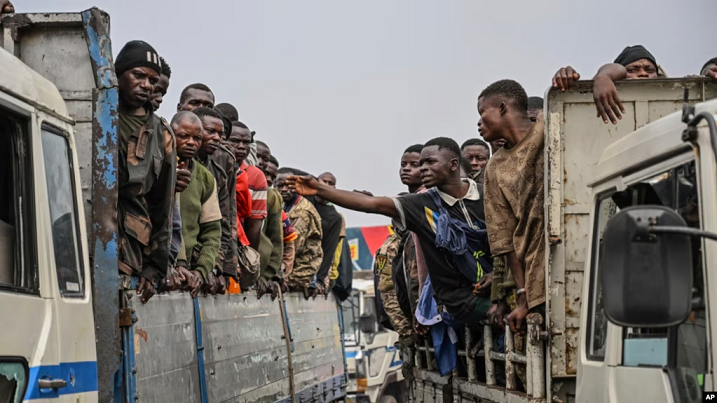
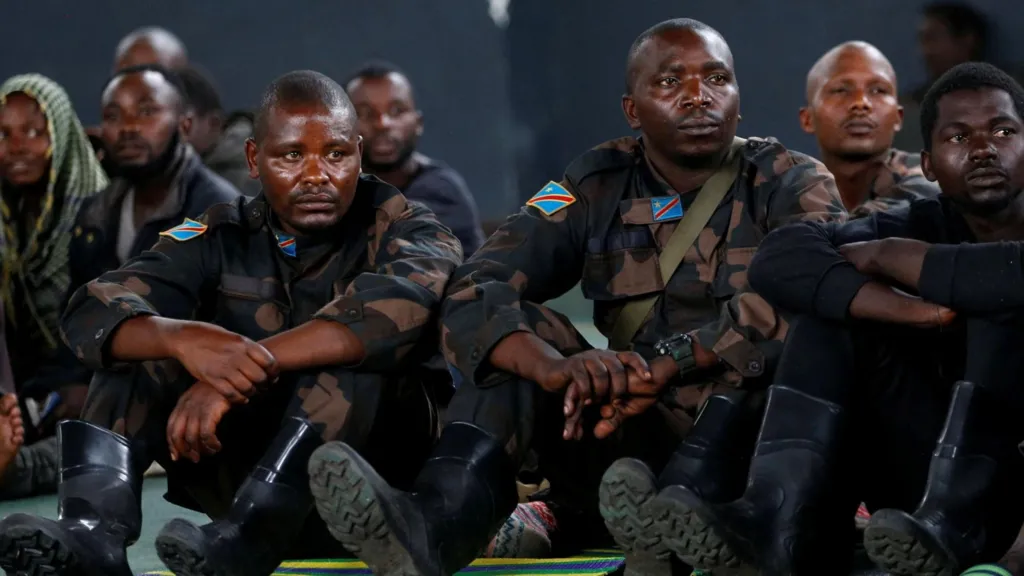
M23 rebels escorted some 2,000 government soldiers and police officers — who they said surrendered — to an undisclosed location, some of them singing anti-Tshisekedi songs.
The U.N. Humanitarian Coordinator in Congo said basic services are largely paralyzed in Goma, a humanitarian hub critical for more than 6 million people displaced by the conflict. “After several days of intense clashes, the city is now (faced) with massive humanitarian needs and severely impacted response capacities,” said Bruno Lemarquis, the humanitarian coordinator.
Footage from Goma showed residents carrying food items and goods looted from stores and warehouses in the city. “This is something that is going to exacerbate a dangerous cycle of violence as desperate times call for desperate measures,” the U.N. World Food Program emergency coordinator in eastern Congo, Cynthia Jones, said Thursday.
South Kivu gripped by fear
After capturing much of Goma, the rebels were advancing toward South Kivu’s provincial capital, Bukavu, causing fear and panic among residents, witnesses said Thursday.
Nana Bintou, a civil society leader, said gunshots and explosions were heard in Mukwinja, a captured town 135 kilometers from Bukavu.
The Congolese military has been weakened after hundreds of foreign military contractors withdrew and handed over their arms to the rebels. Residents of Goma described seeing soldiers changing into civilian clothing and dropping their guns as they crossed over the border to Rwanda or took shelter in foreign peacekeeping bases.
“The (Congolese) military bases in Bukavu have been emptied to reinforce those in Nyabibwe, Bushushu, and Nyamukubi” along the way to the capital, one youth leader said, speaking on the condition of anonymity because he was worried about his safety.
Neighbors urge talks with M23 as tensions grow
A summit of the regional East African bloc called for an immediate and unconditional ceasefire in eastern Congo and “strongly urged” Tshisekedi’s government to hold talks with the rebels. Tshisekedi was conspicuously absent from the virtual summit attended by Rwanda, also a member.
While African countries as well as the U.N. and U.S. have called for an immediate ceasefire, the risk of a regional war has increased, analysts say, exacerbated by the rebels’ advance into South Kivu and diatribes between Rwandan and South African officials. Congo is a member of the southern Africa regional bloc and also that of east Africa, whose peacekeeping force it expelled last year after deeming it ineffective.
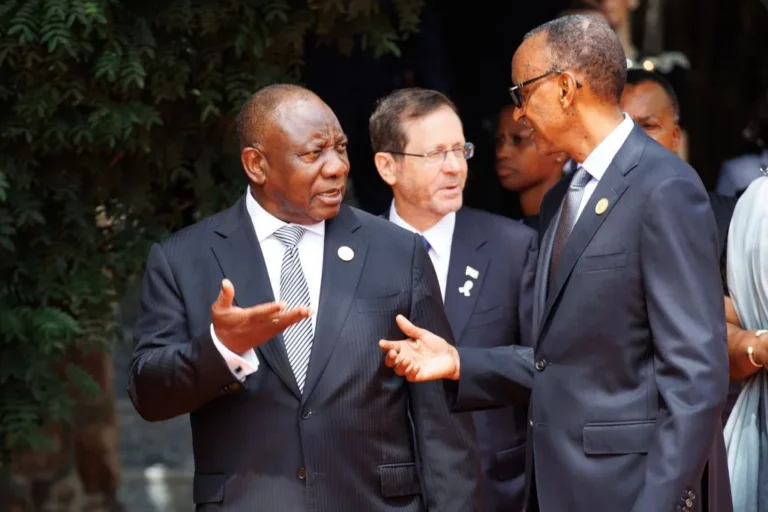
South African President Cyril Ramaphosa blamed the “Rwanda Defense Force militia” for the fighting that has resulted in the deaths of 13 South African peacekeepers in eastern Congo. He also said his government will ensure the peacekeepers are “sufficiently supported during this critical mission.”
His comment drew an angry response from Kagame, who called the South African peacekeepers a “belligerent force” working alongside armed groups that target Rwanda. “If South Africa prefers confrontation, Rwanda will deal with the matter in that context any day,” the Rwandan leader said on the social media platform X.
Who are the M23 and what do they want?
The chaotic situation with the M23 has its roots in ethnic conflict, stretching back to the 1994 genocide in Rwanda, when 800,000 Tutsis and others were killed by Hutus and former militias. M23 says it is defending ethnic Tutsis in Congo. Rwanda has claimed the Tutsis are being persecuted by Hutus and others involved in the genocide. Many Hutus fled into Congo after 1994.
Unlike in 2012 when the rebels seized Congo for days, observers say their withdrawal could be more difficult now. The rebels have been emboldened by Rwanda, which feels Congo is ignoring its interests in the region and failed to meet demands of previous peace agreements, according to Murithi Mutiga, program director for Africa at the Crisis Group, a think tank.
“Ultimately, this is a failure of African mediation (because) the warning signs were always there. Kigali was adopting very bellicose rhetoric and the Congolese government was also adopting very, very aggressive rhetoric,” Mutiga said.
Friday 31 Jan , 2025 {HMC} A male nurse in Uganda has died of Ebola, the first recorded death by the disease in the East African country since an outbreak ended in 2023, health officials said.
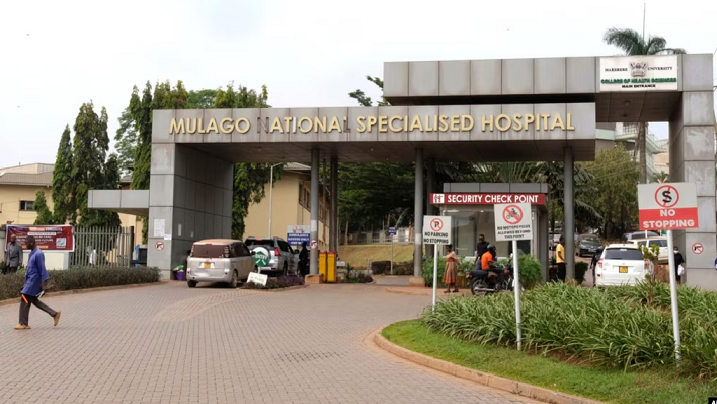
The 32-year-old nurse worked at Mulago National Specialised Hospital in Kampala, Diana Atwine, permanent secretary of Uganda’s health ministry, said Thursday.
The nurse died Wednesday of the Sudan strain of Ebola, Atwine said.
He sought treatment at several hospitals and had also consulted with a traditional healer before tests confirmed an Ebola diagnosis, health officials said.
World Health Organization Director-General Tedros Adhanom Ghebreyesus posted on X that his organization was supporting Uganda’s efforts to contain an Ebola outbreak in Uganda with a $1 million allocation from WHO’s Contingency Fund for Emergencies.
Atwine said on her X social media account that “rapid response teams are fully deployed, contact tracing is underway, and all necessary measures are in place to contain the situation. We assure the public that we are in full control.”
Contact tracing, however, could be challenging in Kampala, with its population of 4 million people.
The health ministry, however, reported that it had identified 44 contacts of the late nurse, which included 30 other health care workers.
The symptoms of Ebola, an often fatal disease, include fever, vomiting, diarrhea, muscle pain, and at times internal and external bleeding.
According to the U.S. Centers for Disease Control and Prevention, health care workers and family members caring for someone with Ebola are at high risk for contracting the disease.
WHO said Ebola “is transmitted to people from wild animals (such as fruit bats, porcupines and non-human primates) and then spreads in the human population through direct contact with the blood, secretions, organs or other bodily fluids of infected people, and with surfaces and materials (e.g., bedding, clothing) contaminated with these fluids.”
Ebola’s fatality rate is around 50%, WHO said on its website, but it also said that fatality rates have varied from 25% to 90% in some outbreaks.
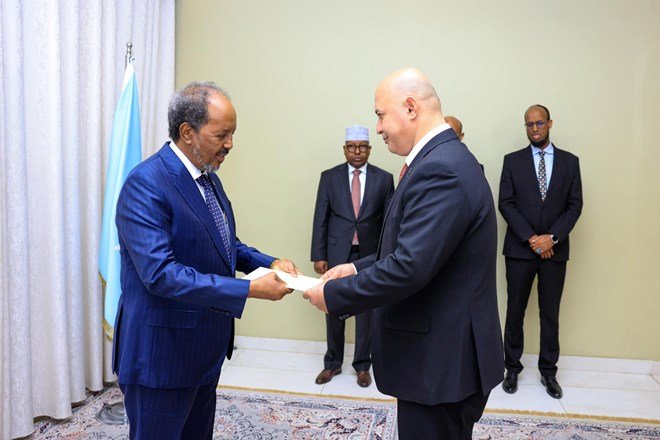
Friday 31 Jan , 2025 {HMC} President Hassan Sheikh Mohamud of the Federal Republic of Somalia has officially received the credentials of eight new ambassadors, marking a significant step in strengthening Somalia’s international relations. The ceremony took place at the Presidential Palace in Mogadishu and signifies Somalia’s commitment to enhancing diplomatic, economic, development, and security cooperation with nations around the world.
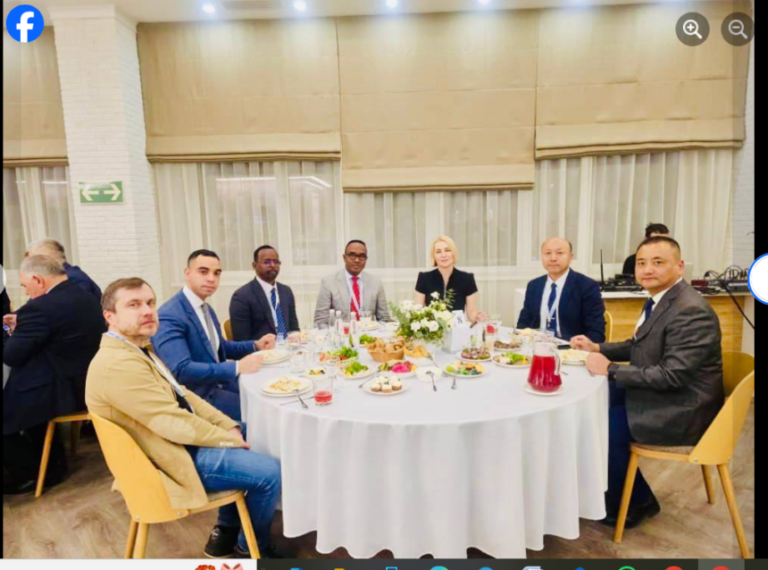
The new ambassadors represent a diverse array of countries, reflecting Somalia’s outreach to both regional neighbors and international partners. The ambassadors who presented their credentials are Ambassador Abdirahman Khalil Ahmed of the Republic of Sudan, Ambassador Rowaid Adil Mohamed of Palestine, Ambassador Morakot Janemathukorn of Thailand, Ambassador Bernard Yohana Kibesse of Tanzania, Ambassador Ana Filomena da Costa Rocha of Portugal, Ambassador Martin K. Ngoga of Rwanda, Ambassador Mahi Boumediene of Algeria, and Ambassador Matsuura Hiroshi of Japan.
President Mohamud expressed optimism about the prospects of enhanced bilateral relations that these appointments signify. He noted the importance of strengthening ties between Somalia and the nations these ambassadors represent, emphasizing that such relationships are crucial for mutual advancement in various sectors. “Welcoming these distinguished ambassadors marks a profound moment for Somalia. It is an affirmation of our shared dedication to fostering partnerships that will drive progress and prosperity for our nations,” he stated.
The ambassadors conveyed their gratitude for the warm reception and expressed their commitment to deepening ties with Somalia. They affirmed their intentions to collaborate closely on initiatives spanning diplomacy, trade, security, and cultural exchange. Their arrival represents not only bilateral enthusiasm but also has broader implications for regional diplomacy, potentially leading to collective security efforts, the development of economic corridors, and humanitarian collaboration.
Somalia’s strategic focus on international cooperation is pivotal for its ongoing development. By embracing these partnerships, the nation aims to boost economic growth through attracting foreign investment and expanding trade opportunities. Enhancing security measures through collaborative initiatives is also a priority, fostering peace and stability within the region. Additionally, promoting cultural exchange is seen as a valuable avenue for encouraging people-to-people connections, building mutual respect, and shared cultural appreciation. Advancing sustainable development by partnering on projects addressing infrastructure, education, healthcare, and environmental sustainability is another key objective.
President Hassan Sheikh Mohamud’s administration has been proactive in re-establishing Somalia’s presence on the international stage. These diplomatic engagements are pivotal for showcasing Somalia’s progress and its aspirations for a peaceful and prosperous future. The accreditation of the new ambassadors is expected to lead to high-level delegations and planned visits between Somalia and these nations to discuss specific collaboration projects. Formalizing partnerships in key sectors through agreements and encouraging private sector partnerships to stimulate economic growth are also anticipated outcomes.
This occasion marks a hopeful and forward-looking chapter in Somalia’s history. The convergence of these international representatives signals a collective belief in Somalia’s potential and a shared commitment to nurturing growth and stability. By embracing these new diplomatic relationships, Somalia is not just opening doors to individual countries but is also reinforcing its role as a rising player in international affairs. The collaborative efforts envisioned by President Mohamud and the newly appointed ambassadors hold the promise of meaningful progress for Somalia and its global partners.
Friday 31 Jan , 2025 {HMC} South Africa and Rwanda’s already fraught diplomatic relations have worsened after President Cyril Ramaphosa accused the Rwanda-backed M23 rebel group of killing South African peacekeepers in eastern Democratic Republic of Congo.
As the rebels gained the upper hand in the battlefield by capturing most of Goma – the biggest city in the east – South Africa fired a diplomatic salvo, warning that further attacks on its troops would be considered a “declaration of war”.
Rwanda’s President Paul Kagame hit back, accusing South Africa of being part of a “belligerent force” involved in “offensive combat operations” to help the Congolese government “fight against its own people”.
A total of 13 South African soldiers have been killed in the fighting since last week as the rebels made a lightning advance towards Goma – a major trading hub on the border with Rwanda.
Last year, another seven South Africans were killed in eastern DR Congo – making it one of the country’s deadliest combat-related tragedies in recent times.
South Africa and Rwanda have long had a difficult relationship.
In 2014, South Africa expelled three Rwandan diplomats after an attack on the home of an exiled Rwandan dissident in Johannesburg.
Kagame’s government responded by expelling six South African envoys.
Tensions seemingly eased after Ramaphosa’s visit to Rwanda last year for commemorations to mark the 30th anniversary of the genocide in which about 800,000 people were killed.
But they have flared up again, following the death of the South Africans who were deployed to eastern DR Congo in December 2023 as part of a regional peace-keeping force sent by the Southern African Development Community (Sadc).
South African soldiers make up the bulk of the force – known by the acronym SAMIDRC – that had the mission of repelling armed groups such as the M23 and bringing peace to the mineral-rich region following decades of unrest.
The latest diplomatic fall-out started with a post shared on Ramaphosa’s X page.
In it, the president confirmed he had spoken to Kagame about the escalating conflict and that both leaders had agreed “on the urgent need for a ceasefire and the resumption of peace talks by all parties to the conflict”.
Ramaphosa also insisted, in a later statement, that the presence of South African troops in DR Congo was not a “declaration of war against any country or state” – an apparent reference to Rwanda.
South Africa’s Defence Minister Angie Motshekga, however, had a slightly different take, telling reporters: “There’s been no hostilities between us, it’s just that when they were firing above our heads, the president did warn them [that] if you’re going to fire, we’re going to take that as a declaration of war.”
But Ramaphosa went further on X, saying the peacekeepers were killed in attacks by the M23 and – he pointedly added – “Rwanda Defence Force (RDF) militia”.
This angered Kagame, who said statements made by South African officials – including Ramaphosa – contained lies and distortion.
“The Rwanda Defence Force is an army, not a militia,” Kagame replied on X.
“President Ramaphosa has never given a ‘warning’ of any kind, unless it was delivered in his local language which I do not understand. He did ask for support to ensure the South African force has adequate electricity, food and water, which we shall help communicate.
“President Ramaphosa confirmed to me that M23 did not kill the soldiers from South Africa, [the Conglese army] FARDC did,” Kagame said.
He added that the regional peacekeepers – who included troops from Tanzania and Malawi – were a “belligerent force” working alongside “genocidal armed groups” that targeted Rwanda, and had “no place in this situation”.
Kagame closed his lengthy statement by saying South Africa was in “no position to take on the role of a peacemaker or mediator” and if the country wanted a confrontation, Rwanda would “deal with the matter in that context any day”.
Kagame’s comments clearly suggested that he wants South Africa to back off from DR Congo, where its military involvement dates back to the late 1990s.
It first joined the UN’s peacekeeping mission, Monusco, following the end of the racist system of apartheid in 1994.
At the time, the South Africa’s military had just emerged from being regarded as a “highly effective apartheid war-time force” to a “peacetime force” left to grapple with reduced funding and a “lack of political direction”, Thomas Mandrup, an associate professor at the country’s Stellenbosch University, told the BBC.
While South Africa has said its involvement in DR Congo was guided by its need to “contribute to the stability” of a fellow Sadc member, defence analyst Dean Wingrin said the country’s economic interests also influenced its decision.
“The DRC is a very big trading partner with [us] because eastern DRC is so rich in minerals. We import a lot of minerals… from the DRC so South Africa has an interest in a peaceful DRC,” he told the BBC.
While Monusco’s mission has largely been about peacekeeping, escalating tensions in the region led to the establishment of the Force Intervention Brigade in 2013 to “actively engage” with the numerous armed groups in eastern DR Congo.
This intervention had initial success in repelling the M23, the most prominent rebel group.
This was partly due to the deployment of South Africa’s attack aircraft – Rooivalk – which had a “devastating effect” on the M23 in a short space of time, according to Mr Wingrin.
The rebel group then effectively melted away and was subsequently expelled from eastern DR Congo – until its recent comeback which has seen it capture much of the region.
However, South Africa’s military has been in no position, this time around, to thwart the rebel group’s advance as it has lost its airpower.
“Unfortunately South Africa’s budget has continued to decline over the years. The air force couldn’t afford to maintain the Rooivalks,” Mr Wingrin said.
“We’re missing that vital aircover that would’ve come in so handy a few days ago but is way too late now,” he said.
Mr Mandrup expressed a similar view, saying South Africa deployed its troops in 2023, ignoring warnings that “you haven’t got the capabilities needed, the defence force is in shambles and you’re facing an opponent that’s much better equipped than in 2013”.
He added that it was difficult for South Africa to bring back its troops at this point because the “forces are locked down and caught in two bases”.
“They can’t get out, get aircover [or] reinforcements. They can’t even get the wounded out,” he said.
Ramaphosa seemed to agree, saying in a recent statement that the situation in the region was “tense, volatile and unpredictable”.
In spite of this, any decision to pull South African troops out of DR Congo ultimately lies with Sadc since SAMIDRC was deployed by the 16-member regional bloc.
There are reports that Sadc is set to take this decision at a summit taking place on Friday.
For Mr Wingrin, there was a need for the South African government to do “serious introspection” over its military involvement in DR Congo.
“Is it something they want to push at all costs and what is it worth to South Africa to have sons and daughters dying so far away?” he asked.
So, South Africa’s president appears to have a difficult choice – keep his soldiers in DR Congo and risk further deaths, or the embarrassment of pulling them out, presumably after negotiating safe passage for them with Rwanda.
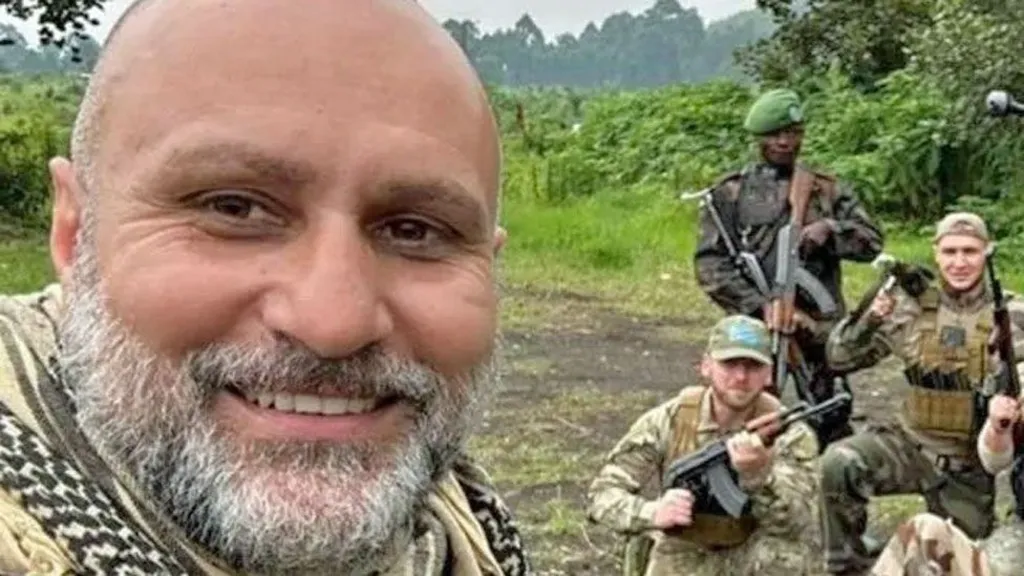
Friday 31 Jan , 2025 {HMC} It has been a humiliating week for nearly 300 Romanian mercenaries recruited to fight on the side of the army in the Democratic Republic of Congo.
Their surrender following a rebel assault on the eastern city of Goma has also shattered the dreams of those who signed up for the job to earn big money.
The BBC has seen contracts that show that these hired soldiers were being paid around $5,000 (£4,000) a month, while regular military recruits get around $100, or sometimes go unpaid.
The Romanians were contracted to help the army fight the Rwanda-backed M23 rebels, who say they are fighting to protect the rights of DR Congo’s minority ethnic Tutsis.
When the offensive on Goma started on Sunday night, the Romanians were forced to take refuge at a UN peacekeeping base.
“The M23 rebels were supported by troops and state-of-the-art military equipment from Rwanda and managed to reach our positions around the city of Goma,” Constantin Timofti, described as a co-ordinator for the group, told Romanian TVR channel on Monday.
“The national army gave up fighting and we were forced to withdraw.”
Romania’s foreign ministry spokesman Andrei Țărnea told the BBC that “complex” negotiations followed, which saw the M23 hand over the Romanian fighters – whom he described as private employees of the DR Congo government on an army training mission – to Rwanda.
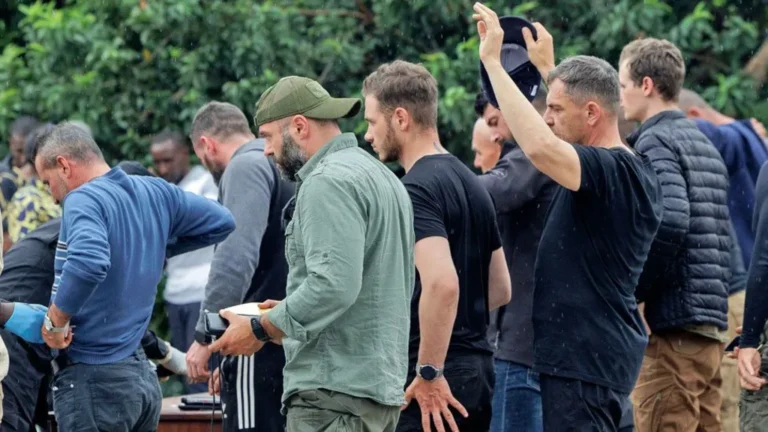
Goma sits right on the border with Rwanda – and the mercenaries were filmed by journalists as they crossed over, surrendering to body searches and other checks.
Before they crossed over, phone footage shows M23 commander Willy Ngoma berating one of the Romanians in French, telling him to sit on the ground, cross his legs and put his hands over his head.
He asked him about his military training – it was with the French Foreign Legion, the Romanian replied.
“They recruited you with a salary of $8,000 a month, you eat well,” Ngoma yelled, pointing out the disparity between that and a Congolese army recruit’s pay.
“We are fighting for our future. Do not come for adventure here,” he warned.
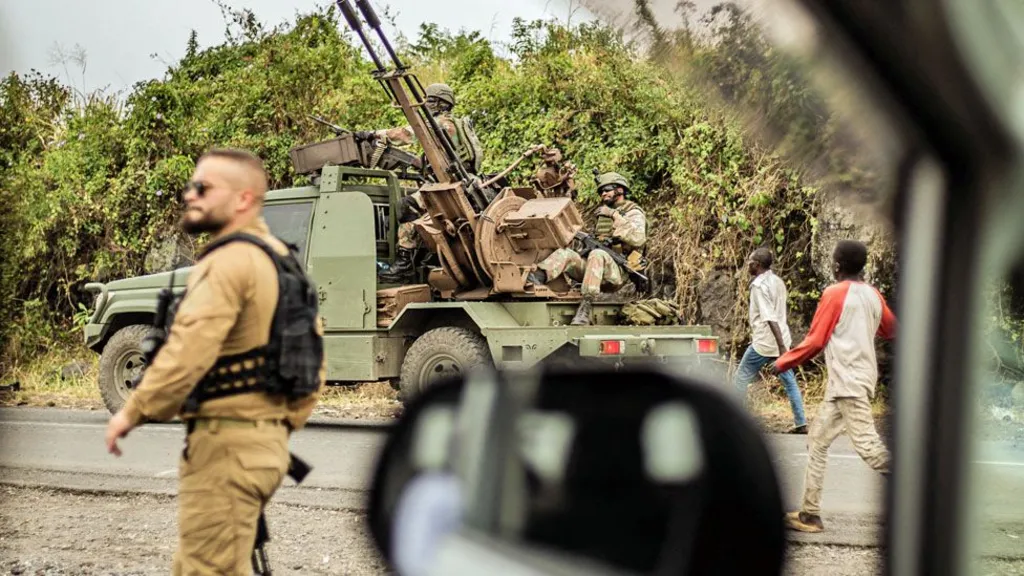
The mercenaries were working with the Congolese army – seen here earlier in January north-west of Goma
It is not clear where Ngoma got the $8,000 figure, but the contract shown to the BBC by a former Romanian mercenary in October detailed that “strictly confidential remuneration” for senior personnel started at $5,000 per month during active duty and $3,000 during periods of leave.
The agreement outlines an “indefinite period” of service, with contractors scheduled to take a one-month break after every three months of deployment.
I had met the ex-mercenary in Romania’s capital, Bucharest, where I had gone to investigate Asociatia RALF, which a group of UN experts say is a Romanian enterprise with “ex-Romanians from the French Foreign Legion”.
It is headed by Horațiu Potra, a Romanian who describes himself as a military instructor.
In June while in Goma, I had noticed such mercenaries at checkpoints and deployed around the city, working closely with army.
Over the last three years, others have reported seeing them driving Congolese troops in army vehicles.
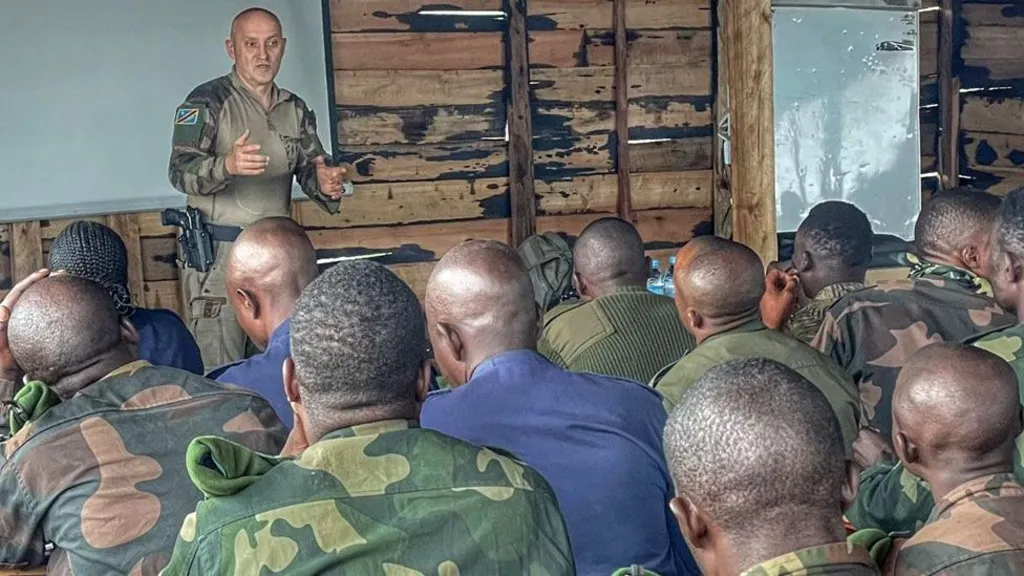
Horațiu Potra took on a central role when it came to training troops in DR Congo
“When they arrived, everyone referred to them as Russian,” Fiston Mahamba, co-founder of disinformation group Check Congo, told the BBC.
“I think this was linked to the Russian mercenary group, Wagner with presence in several African countries.”
In fact, Asociatia RALF may also work across Africa – its contract stipulated that it had various “operational locations”, including “Burkina Faso, DR Congo, Ivory Coast, Niger, Senegal, Sierra Leone, Gambia and Guinea”.
The UN experts say that two private military companies were brought on board to bolster its forces in 2022, not long after the M23 had regrouped and begun capturing territory in North Kivu.
The province has been unstable for decades with numerous militias operating there making money from its minerals like gold and coltan – used to make batteries for electric vehicles and mobile phones.
The first firm that was signed up was Agemira RDC, headed by Olivier Bazin, a French-Congolese national. The experts say the company employed Bulgarian, Belarusian, Georgian, Algerian, French and Congolese nationals.
This outfit was tasked with refurbishing and increasing DR Congo’s military air assets, rehabilitating airports and ensuring the physical security of aircraft and other strategic locations.
A second contract was signed between Congo Protection, a Congolese company represented by Thierry Kongolo, and Asociatia RALF.
According to the UN experts, the contract specified that Asociatia RALF had expertise and extensive experience in the provision of security management services.
It would provide training and instruction to the Congolese troops on the ground by means of a contingent of 300 instructors, many of them Romanians.
When I spoke to Mr Potra in July about the extent of his group’s involvement on the ground and whether it had engaged in fighting, he said: “We have to protect ourselves. If M23 attacks us, they won’t simply say: ‘Oh, you’re just instructors – go home’.”
Mr Potra was hands-on during the DR Congo mission until a few months ago when he returned to Romania – and has since been embroiled in a controversy amid the annulled presidential election there.
He was dramatically arrested in December and has since denied providing security for the pro-Russian, far-right candidate Călin Georgescu. And since October, he has refused to return the BBC’s calls.
The ex-mercenary, who was in his late forties and spoke to the BBC on condition of anonymity, said he had resigned because he was unhappy about how Asociatia RALF was operating.
He said the Romanians did much more on the ground in North Kivu province: “Only a very small number of us were actually trainers.
“We worked long shifts of up to 12 hours, guarding key positions outside Goma.”
He maintained the pay was not worth the risks the military contractors had to take.
“Missions were disorganised, working conditions poor. Romanians should stop going there because it’s dangerous.”
He also claimed that proper background checks had not been done, and some of the Romanian recruits had no military training – citing as an example that one of his former colleagues was a firefighter.
DR Congo’s government has not replied to a BBC request for comment on whether background checks were carried out, or about the pay disparity between the private contractors and Congolese troops.
The family of Vasile Badea, one of two Romanians who were killed last February when an army convoy was ambushed by the M23 fighters on its way to Sake, a frontline town near Goma, told the BBC he had been a police officer.
The 46-year-old had taken a sabbatical from the force and took up the role in DR Congo because of the lucrative salary offer.
The policeman was struggling to pay for an apartment he had just acquired and needed more money.
Vasile Badea was on a sabbatical from the police when he was killed in DR Congo last year
Many more Romanians were lured by the prospects of a well-paid job.
I met one man in Bucharest in October, who was back home looking for more recruits to go to Goma. He had a military background and had done Nato tours in Afghanistan with the Romanian army.
“We are very busy trying to find 800 people who need to be mentally prepared for the job and know how to fight,” the mercenary recruiter told the BBC.
He said he did not work for Asociatia RALF, but refused to say which outfit he was with.
“The recruits will be placed in positions corresponding to the level of their training, earning between $400-$550 per day,” he explained.
When asked about the recruitment process, he emphasised its confidentiality.
“Such jobs are not published anywhere,” he said, adding that networks like WhatsApp were preferred.
He showed me a WhatsApp group where more than 300 Romanians had signed up, many of whom were ex-military personnel.
In June last year, Rwanda’s government spokesperson Yolande Makolo hit out about the presence of mercenaries in eastern DR Congo, saying it was a violation of the Geneva Conventions, which prohibit the use of hired combatants.
In response, Congolese government spokesperson Patrick Muyaya dismissed what he called Rwanda’s perennial complaint.
“We have some instructors who come to train our military forces because we know we have this urgent situation,” he told the BBC.
Congolese soldiers get around $100 a month – and one recruit told the BBC salaries were often not paid or were delayed
But a Congolese soldier I met in June expressed his dismay over the army’s strategy.
“The pay is unfair. When it comes to fighting, we are the ones sent to the front lines first,” he told the BBC on condition of anonymity.
“They [the mercenaries] only come as back-up.”
He confirmed his pay was set at around $100 a month but was often delayed or unpaid altogether.
I was last in contact with him a week ago when he confirmed he was still stationed in Kibati, near Goma, where the army has a base.
“Things are very bad,” he said in a voice note to me.
I have not been able to get hold of him since – and the Kibati base has since been overrun by the M23 with many soldiers killed, including his commander.
Observers say the quick fall of Goma points to DR Congo’s fractured defence strategy, where overlapping forces and blurred lines of command have ultimately played into the hands of M23.
Richard Moncrief, International Crisis Group’s project director for the Great Lakes, points out that as well as mercenaries, the Congolese army works with troops from the Southern African Development Community (Sadc), a local militia known as Wazalendo, as well as soldiers from Burundi.
“It creates a situation where it’s impossible to plan military offences where chain of command and responsibility is muddied,” he told the BBC.
“I think that it’s important to work towards far greater coherence in the armed effort in North Kivu, probably involving a reduction in the number of armed groups or armed actors on the ground.”
For the ex-mercenary, the fate of his former Romanian colleagues has not come as a surprise.
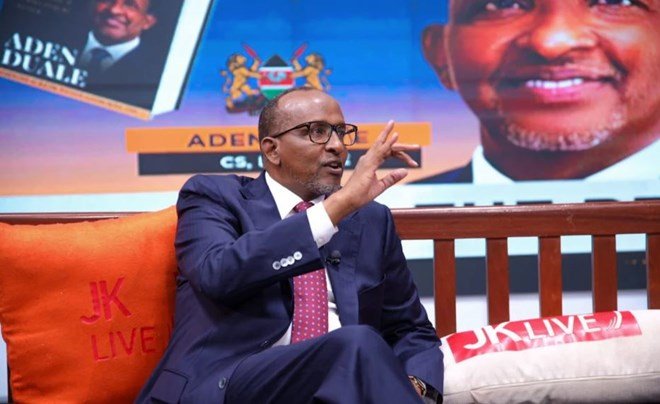
Friday 31 Jan , 2025 {HMC} Environment Cabinet Secretary Aden Duale has taken issue with Citizen TV for describing Garissa, Wajir, and Mandera counties as the “Somali region” during a news report.
Speaking on Thursday, Duale expressed his dissatisfaction with the term, which the media house, owned by Royal Media Services (RMS), used while covering a High Court ruling.
The court had annulled the 2019 Kenya National Bureau of Statistics (KNBS) census results for the three counties, citing major irregularities.
Duale condemned the ‘Somali’ reference, calling it absurd, irresponsible, and discriminatory.
He accused the media outlet of violating journalistic ethics and engaging in ethnic profiling.
“Somali region? Absurd, irresponsible, discriminatory, and ethnic profiling journalism. Garissa, Wajir, and Mandera counties are within the sovereign and territorial borders of the Republic of Kenya,” Duale asserted.
He emphasized that the three counties are integral to Kenya’s sovereignty and dismissed any suggestion otherwise as unethical and misleading.
Duale further demanded an apology from Citizen TV, accusing the station of aligning with those who manipulated the 2019 census results.
“Royal Media Service must correct and apologize. You are not different from those who schemed to doctor the census results in 2019 of that region. Kenya is one united country,” Duale added.