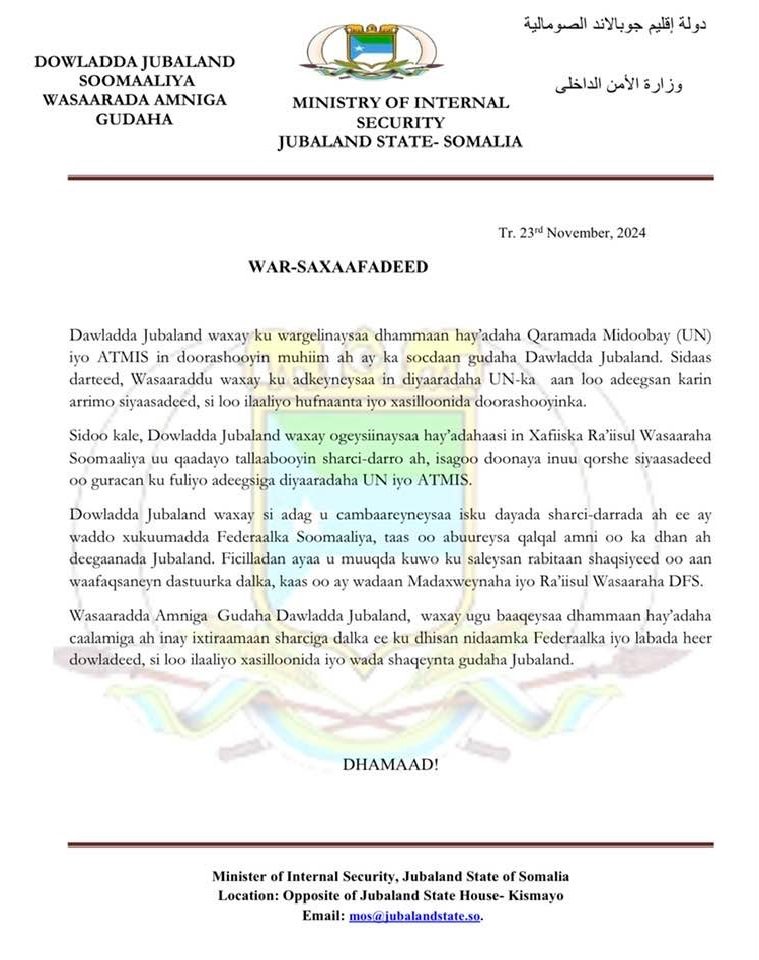
Sabti 23, Nov 2024 {HMC} War saxaafadeedka waxaa lagu yiri ” Jubaland waxay ku wargelinaysaa dhammaan hay’adaha Qaramada Midoobay (UN) iyo ATMIS in doorashooyin muhiim ah ay ka socdaan gudaha Jubbaland.
Sidaas darteed, Wasaaraddu waxay ku adkeyneysaa in diyaaradaha UN-ka aan loo adeegsan karin arrimo siyaasadeed, si loo ilaaliyo hufnaanta iyo xasilloonida doorashooyinka”.
Sidoo kale, Wasaaradda amniga ee Dowlad Goboleedka Jubaland waxay ku wargelisay hay’adahaasi eedo kulul oo ay ujeedisay Xukuumadda oo ay sheegtay in Xafiiska Ra’iisul Wasaaraha Soomaaliya uu qaadayo tallaabooyin ay ku tilmaamtay mid sharci-darro ah oo lagu doonayo in qorshe siyaasadeed oo guracan lagu fuliyo adeegsiga diyaaradaha UN iyo ATMIS.
War saxaafadeedka kasoo baxay Jubbaland ayaa sidoo kale lagu xusay in Jubbaland ay si adag u cambaareyneyso isku dayo ay sheegtay inuu sharci-darro yahay oo ay waddo xukuumadda Federaalka Soomaaliya, taas oo abuureysa qalqal amni oo ka dhan ah deegaanada Jubbaland, wasaaradda waxa ay ku tilmaamtay Ficilladan kuwo ku saleysan rabitaan shaqsiyeed oo aan waafaqsaneyn dastuurka dalka, kaas oo ay wadaan Madaxweynaha iyo Ra’iisul Wasaaraha DFS.
Wasaaradda Amniga Gudaha Jubbaland, ayaa ugu baaqday dhammaan hay’adaha caalamiga ah inay ixtiraamaan sharciga dalka ee ku dhisan nidaamka Federaalka iyo labada heer dowladeed, si loo ilaaliyo xasilloonida iyo wada shaqeynta gudaha Jubaland.
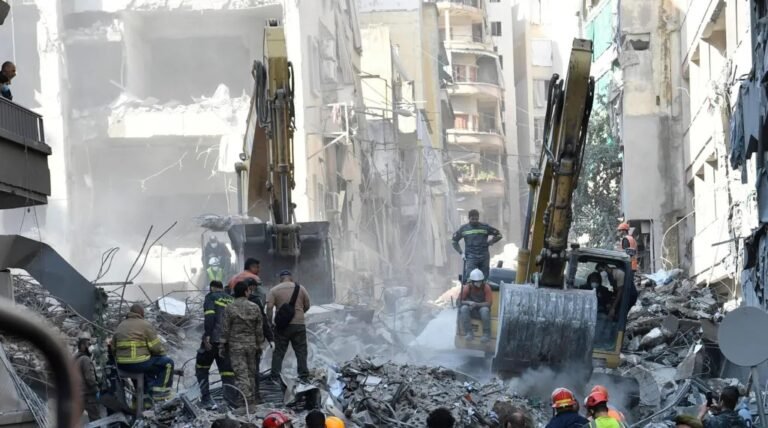
Saturday 23, Nov 2024 {HMC} A massive Israeli air strike on central Beirut has killed at least 15 people, Lebanese officials say, destroying an eight-storey building in the latest attack on the capital city.
Explosions shook the city following the strike on the densely populated Basta district, which happened without warning at about 04:00 (02:00 GMT) on Saturday.
Lebanon’s National News Agency said Saturday’s attack included a bunker buster bomb, a type of weapon previously used by Israel to kill senior Hezbollah figures, including then-leader Hassan Nasrallah.
This could indicate that a high-level official was the possible target, but there has been no immediate comment from either the Israeli military or Hezbollah.
All morning, emergency workers used heavy machinery to remove the rubble and retrieve bodies.
The Lebanese health ministry said more than 60 people had been wounded, and that the number of victims was expected to rise as DNA tests would be carried out on body parts that had been recovered.
“It was a very horrible explosion. All the windows and glasses were over me, my wife and my children. My home now is a battlefield,” said 55-year-old Ali Nassar, who lived in a nearby building.
“One person is hiding here… Should you destroy three buildings where people are sleeping inside? Is it necessary to kill all the people for one person? Or we’re not humans? That’s what I’m asking.”
Also on Saturday, the Israel Defense Forces (IDF) carried out further air strikes on the Dahieh, the area in southern Beirut where Hezbollah is based, saying they were buildings linked to the group.
Israeli attacks have also hit the south, where an Israeli ground invasion is advancing, and the eastern Bekaa Valley, two areas where Hezbollah has strong presence.
In the past two weeks, Israel has intensified its campaign against Hezbollah, the Iran-backed militia and political movement, amid international efforts for a ceasefire, in what appears to be a strategy to pressure the group to accept a deal.
The escalation comes as renewed negotiations to end more than one year of conflict showed initial signs of progress. This week, Amos Hochstein, who has led the Biden administration’s diplomatic efforts, held talks in Lebanon and Israel to try to advance a US drafted deal.
Since the conflict intensified in late September, Lebanese authorities have said any deal should be limited to the terms of United Nations Security Council Resolution 1701, which ended the 2006 war between Hezbollah and Israel.
The resolution includes the withdrawal of Hezbollah’s fighters and weapons in areas between the Blue Line – the unofficial frontier between Lebanon and Israel – and the Litani river, about 30km (20 miles) from the boundary with Israel.
Israel says that was never fully respected, while Lebanon says Israeli violations included military flights over Lebanese territory.
The proposal being discussed, according to a Western diplomat who spoke on condition of anonymity, includes a 60-day ceasefire which would see the withdrawal of Israeli forces from southern Lebanon and the removal of Hezbollah’s presence from the area. The Lebanese military would then boost its presence there, with thousands of extra troops.
But disagreements over some elements remained, the diplomat added, including about the timeline for an Israeli pull-out and the formation of an international mechanism to monitor the agreement.
Hezbollah, and its main supporter Iran, have both indicated being interested in a deal, according to a senior Lebanese source. After the initial shock, the group has reorganised itself, and it continues to carry out daily attacks on Israel, although not with the same intensity, and confront invading Israeli soldiers in Lebanon’s south.
On Thursday, Hezbollah’s Secretary General Naim Qassem said the group had received the US proposal, clarified its reservations, and that it was allowing the talks to go ahead to see if they produced any results. He said that the conditions for a deal were a complete cessation of hostilities and the preservation of Lebanon’s sovereignty.
Hezbollah was ready for a long fight, he added.
Israel’s stated goal in its war against Hezbollah is to allow the return of about 60,000 residents who have been displaced from communities in northern Israel because of the group’s attacks.
In Lebanon, the conflict has killed more than 3,500 people and forced more than one million from their homes, Lebanese authorities say.
A team from Kenya’s Elite Special Operations Group (SOG) conducted a meticulously planned, intelligence-driven operation in the Najo area.
Police said the decisive action marks yet another victory in the squad’s unwavering mission to safeguard the nation.
Saturday 23, Nov 2024 {HMC} A terror suspect was shot and killed in a confrontation with police on Friday in Fafi, Garissa county.
The area is under the multi-agency security operation and is near the Kenya-Somalia border.
It is seen as breeding ground for terror groups from the neighbouring Somalia through the porous border.
A team from Kenya’s Elite Special Operations Group (SOG) conducted a meticulously planned, intelligence-driven operation in the Najo area.
The operation led to a dramatic confrontation with suspected al Ahabaab terrorists, police said.
Following a fierce exchange of fire, one terrorist was killed and a significant cache of weaponry recovered.
They included three AK-47 rifles and magazines, an RPG launcher, an RPG warhead, VHF radios, detonators and other materials police believe were intended for a heinous plot on Kenyan soil.
Police said the decisive action marks yet another victory in the squad’s unwavering mission to safeguard the nation.
Their commitment to ensuring the safety of all Kenyans remains steadfast, police said.
The team extended gratitude to the local community for their vigilance and collaboration in reporting suspicious activities, which are vital in the fight against terror.
The security agencies have vowed to protect Kenyans and will always remain vigilant.
This is the latest such operation to be staged in the area amid fears the group is trying to establish a base for fresh attacks.
Security operations have thwarted dozens of planned attacks in the area and inland.
Fafi has been facing an increase in terror related attacks largely due to its close proximity to the Somalia border.
The border areas of Mandera, Wajir, Lamu and Garissa too have faced similar attacks which have affected development at large.
The government says they have acquired more resources to enhance operations in the border area against the terrorists.
The attacks have left many dead and displaced dozens of families hence affecting development.
Kenyan security forces have been staging operations to tame their activities.
Somalia has not had a stable government since 1990 to help in addressing such attacks.
Saturday 23, Nov 2024 {HMC} On Thursday, the Ukrainian city of Dnipro was hit by a Russian air strike which eyewitnesses described as unusual, triggering explosions that went on for three hours.
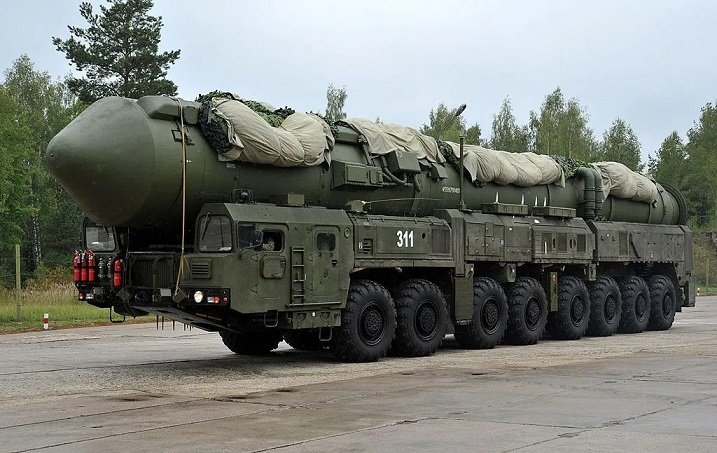
The attack included a strike by a missile so powerful that in the aftermath Ukrainian officials said it bore the characteristics of an intercontinental ballistic missile (ICBM).
Western officials were quick to deny this, saying that such a strike would have triggered a nuclear alert in the US.
Hours after the strike, Russian President Vladimir Putin, in a TV address, said that Russia had launched a “new conventional intermediate-range” missile with the codename Oreshnik, meaning hazel tree in Russian.
Putin said that the weapon travelled at a speed of Mach 10, or 2.5-3km per second (10 times the speed of sound), adding that “there are currently no ways of counteracting this weapon”.
He said that a major military-industrial site in Dnipro, used to manufacture missiles and other armaments, had been hit. He described the attack as a test which was “successful” because the “target was reached”.
Speaking a day later to senior defence officials, he said tests of the missile would continue, “including in combat conditions”.
Putin’s description of the weapon notwithstanding, there seems to be no clear consensus about what it actually is.
Ukrainian military intelligence maintains that the missile is a new type of ICBM known as Kedr (cedar). They say it was travelling at Mach 11 and took 15 minutes to arrive from the launch site, more than 1,000km (620 miles) away in the Astrakhan region of Russia.
They said the missile was equipped with six warheads, each with six sub-munitions.
This assumption is backed up by BBC Verify’s examination of video footage of the strike. Most of it is blurry or of poor quality, but it clearly shows six flashes against the night sky, each comprised of a cluster of six individual projectiles.
The location that was hit is an industrial area to the southwest of Dnipro city.
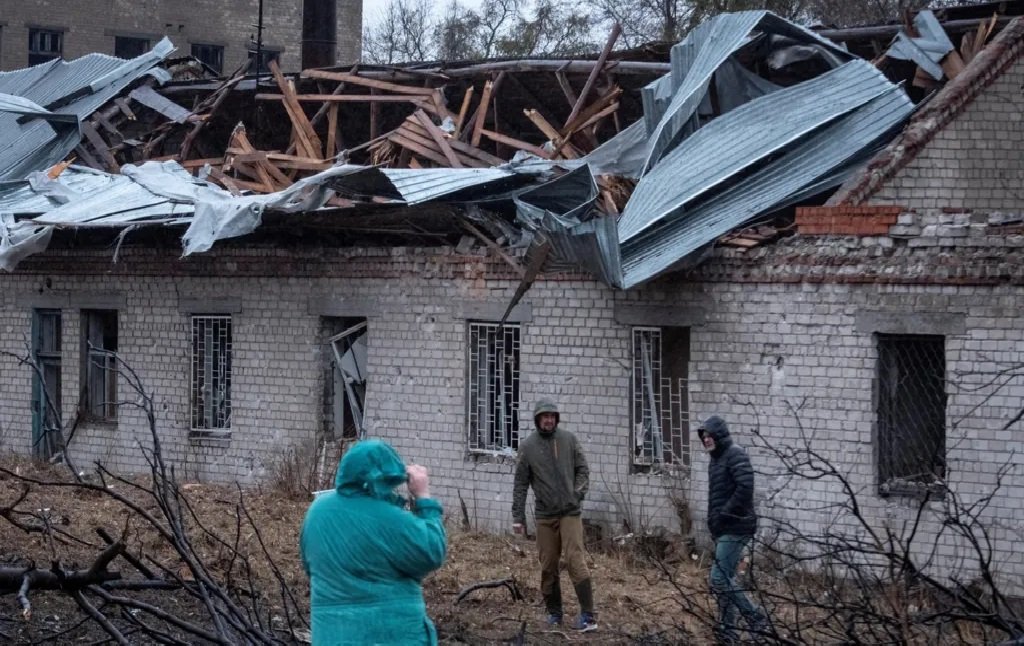
Damage caused by Thursday’s attack on Dnipro, carried out by the Oreshnik in combination with other missiles
Why is speed important?
If Putin’s description is correct, the missile is at the upper edge of the definition of hypersonic, and few things can achieve this.
Speed is important because the faster a missile travels, the quicker it gets to target. The quicker it gets to target, the less time a defending military has to react.
A ballistic missile generally gets to target by following an arcing path up into the atmosphere and a similar one down towards its destination.
But as it descends, it picks up speed and gains kinetic energy, and more kinetic energy gives it more options. This allows it to manoeuvre down towards the target – by performing some kind of defending wriggle – that makes interception by surface-to-air missile systems (such as Ukraine’s US-built Patriot defence missile system) particularly difficult.
This is not new for militaries that have to defend against such threats of course, but the greater the speed, the harder it becomes.
That is why Putin has likely placed emphasis on its speed in announcing this new type of missile.
Some 80% of the missiles fired by Russia have been intercepted by Ukraine, an extraordinary figure. But these faster speeds of ballistic missiles are intended to try to bring that percentage down.
What is the new missile’s range?
Russian military expert Ilya Kramnik told the pro-Kremlin newspaper Izvestiya it is likely that the new missile, whose development has been classified until now, is at the upper end of medium-range missiles.
‘It is likely that we are dealing with a new generation of Russian intermediate-range missiles [with a range of] 2,500-3,000km (1,550-1,860 miles) and potentially extending to 5,000km (3,100 miles), but not intercontinental,” he says.
This could put almost the whole of Europe within range, but not the US.
“It is obviously equipped with a separating warhead with individual guidance units,” Kramnik added.
He suggested that it could be a reduced version of the Yars-M missile complex, which is an ICBM.
Russia was reported to have started production of a new version of this missile complex last year which included much more mobile independent warheads.
Another expert, Dmitry Kornev, told the paper the Oreshnik could have been created on the basis of the shorter-range Iskander missiles – already commonly used on Ukraine – but with a new-generation engine.
An Iskander with an enlarged engine was used at the Kapustin Yar test site in southern Russia last spring, he said, adding that this may well have been the Oreshnik. Thursday’s missile was fired into Ukraine from the same site.
How effective could it be?
Military analyst Vladislav Shurygin told Izvestiya that the Oreshnik was capable of overcoming any existing modern missile defence systems.
It could also destroy well-protected bunkers at great depths without using a nuclear warhead, he said, although there is no evidence of underground facilities being destroyed at the Dnipro plant.
Another Russian analyst, Igor Korotchenko, told Tass news agency the missile had multiple independently guided warheads, adding that the “practically simultaneous arrival of the warheads at the target” was extremely effective.
Justin Crump, CEO and founder of the risk advisory company Sibylline, told BBC Verify that the missile had the capacity to seriously challenge Ukraine’s air defences.
“Russia’s short range ballistic missiles have been one of the more potent threats to Ukraine in this conflict,” he said. “Faster, more advanced systems would increase that an order of magnitude.”