



Isniin 17, March 2025 {HMC} Dhageystayaal halkan waxa aan idiin kugu soo gudbi neynaa Warka subaxnimo ee Warbaahinta Hiiraanweyn
Warka waxaa soo jeedinayo ::Yaasiin Ali Ahmed
Farsamadii ::Mohamed Baryare Haamud

Isniin 17, March 2025 {HMC} Dhageystayaal halkan waxa aan idiin kugu soo gudbi neynaa Warka subaxnimo ee Warbaahinta Hiiraanweyn
Warka waxaa soo jeedinayo ::Yaasiin Ali Ahmed
Farsamadii ::Mohamed Baryare Haamud
The BBC has heard evidence of atrocities committed by retreating fighters in a battle raging for control of Sudan’s capital city Khartoum.
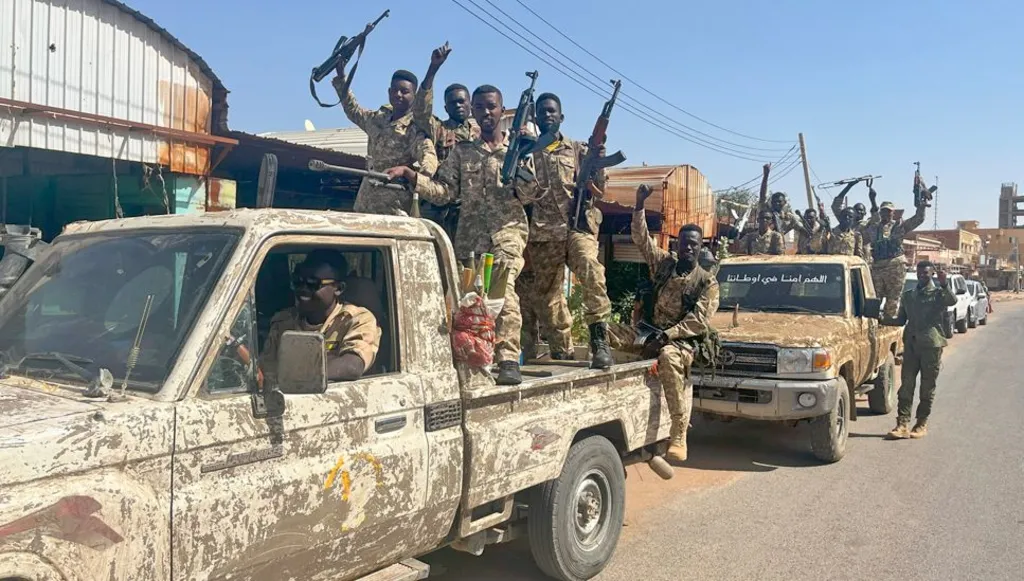
The city has been held by the paramilitary Rapid Support Forces (RSF) since the start of the country’s brutal civil war nearly two years ago – but the army has retaken much of it and believes it is on track to seize the rest.
Regaining the capital would be a tremendous victory for the military and a turning-point in the war, although by itself would not end the conflict.
In recent weeks troops have mostly encircled Khartoum, coming up from the south after surging through central Sudan, and clearing city districts in the north and east, squeezing the remaining RSF fighters into the centre.
Vast areas of the reclaimed territory are completely destroyed.
Travelling with the army, we drove past block after block of damaged and ransacked buildings – some of them blackened by fire, many pockmarked with bullet holes.
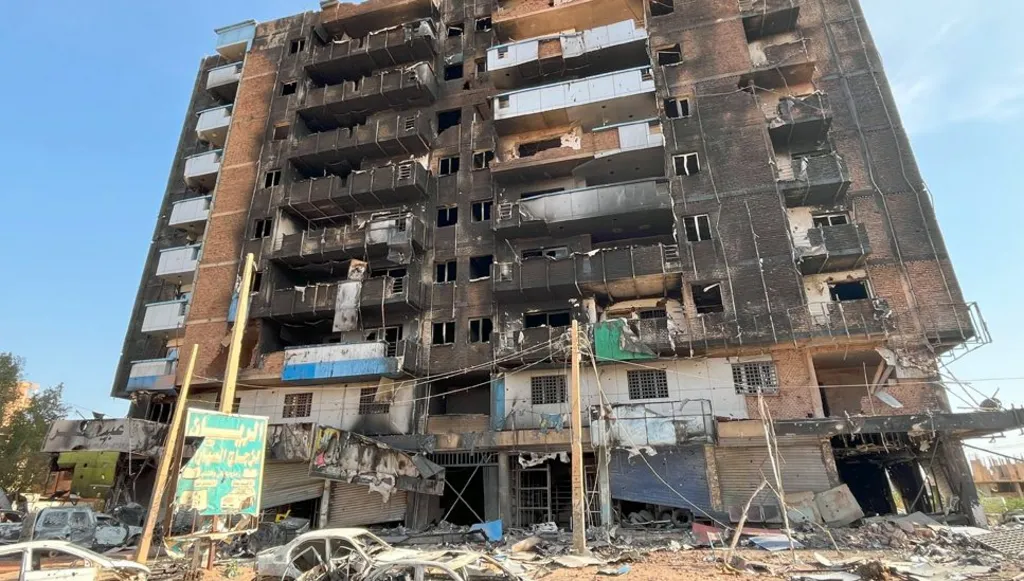
The pavements in front of them were littered with vandalised vehicles, pieces of discarded furniture, the soiled remains of looted goods and other debris.
But even in places that look untouched, the terror is fresh.
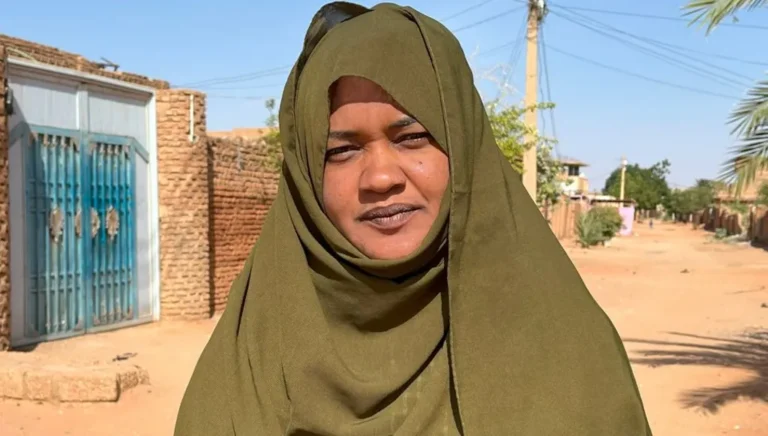
In Haj Yusuf, a district of Khartoum east of the River Nile, residents described chaos and violence as fleeing RSF fighters turned on civilians.
“It was a shock, they came suddenly,” says Intisar Adam Suleiman.
Two of her sons, 18-year-old Muzamil and 21-year-old Mudather, were sitting by the house with a friend. The RSF soldiers ordered them inside, then shot them in the back as they entered the gate, says Ms Suleiman.
Muzamil escaped with a bullet wound in his leg but “our friend died instantly”, he told me.
“Then the men wanted to enter the house, and my mother tried to hold the door shut, pushing and pushing. They spotted a phone on the ground, grabbed it and left. I went and called the father of my friend so he could come and do first aid, but we couldn’t rescue him.”
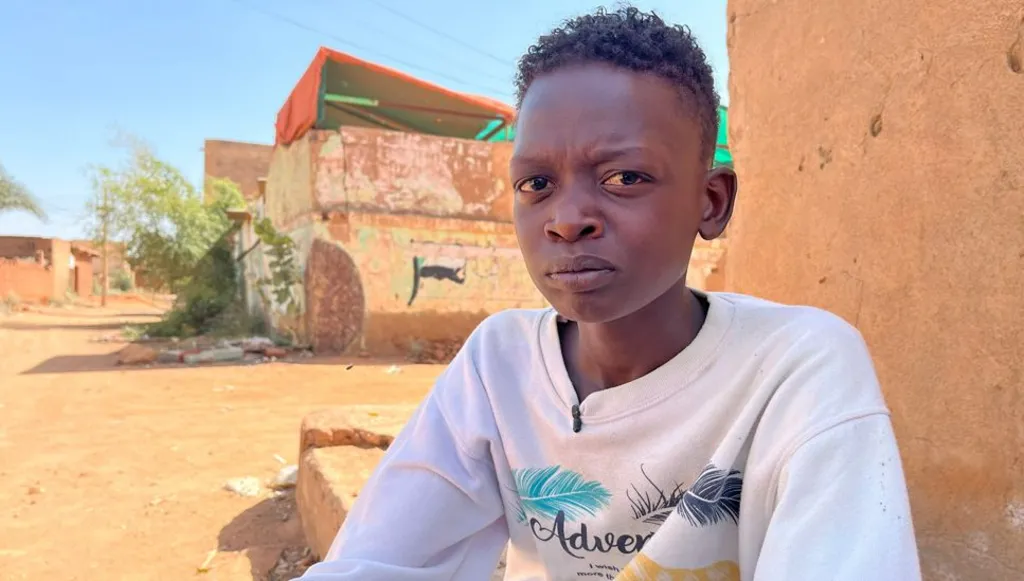
Mudather died the next morning because the hospital’s blood bank had been decimated by a long power outage and he could not get the transfusion he needed.
Ms Suleiman says she knew the RSF soldiers and had engaged with them before to try and de-escalate violence.
One of them had told her: “We came for death, we are people of death.”
She says she told them: “If you came for death, this is not the place for death.”
Yet too much death is what Ms Suleiman has seen in this war.
So many people have died, she says: “I’ve become used to these traumas.”
A few blocks away, Asma Mubarak Abdel Karim tells me she and a group of women got caught up in the fighting as Sudanese forces closed in.
She says they were confronted by retreating RSF soldiers who accused them of siding with the military because they had been to a market in army-held territory.
“They shot on the ground around us, around our feet, terrifying us,” she says, explaining how they then pulled one woman into an empty house and raped her.
She says the RSF fighter held the woman at gunpoint and told her: “Come with us.”
He was beating her with his weapon, says Ms Karim.
“And then we heard shooting and the man ordering her to: ‘Take it off! Do this! Do that!’ Then the fighting around us intensified and we couldn’t hear any more – bullets were falling in the area, so we hid inside the house.”
She wipes away tears when asked what the best thing about the situation is for her now.
“Security,” she says softly, “the best thing is security. They tortured us so terribly.”
An RSF spokesman denied the reports, saying the group had controlled this area for two years “without any major crimes” and that “massive killings” had been reported in areas taken by the military.
The army and allied militias have been accused of carrying out widespread atrocities after recapturing territory, in particular the central Gezira state.
The UN and US say both sides have committed war crimes, but singled out the RSF for criticism of mass rape and accusations of genocide.
It is not only the RSF foot soldiers who are on the move.
Top officials have abandoned their homes in the nearby affluent suburb of Karfuri.
The RSF elite had embedded itself into Khartoum’s establishment before the paramilitary group and the army turned on each other in April 2023 in a battle for control.
Karfuri is now eerily empty and thoroughly looted.
Even the house of the RSF’s deputy commander, Abdel Rahim Hamdan Dagalo, and brother of the group’s leader, was not spared.
The big empty swimming pool in the yard is scattered with rubbish.
Sofas in the spacious rooms are overturned, the windows broken, gold jewellery boxes are bare, the door of a waist-high safe has been pulled off.
The army says it believes that most of the RSF senior leadership is now outside the city, and that those still fighting for the heart of Khartoum are the junior commanders and lower-ranking soldiers.

We were told the military was using drones to drop leaflets urging remaining fighters to leave rather than fight street by street.
The samples we were shown are written in Arabic but also French, apparently directed at foreign fighters from neighbouring Chad.
“Lay down your weapon, change into civilian clothes, and leave the area to save your life,” says one.
In Khartoum North, closer to the Nile, the RSF was pushed out several months ago, but the calm is regularly punctured by the sound of shelling as the army fires at the group’s positions across the river.
Many people here say they finally feel safe enough to sleep at night but are still taking stock of extensive damage.
Zeinab Osman al-Haj showed me the wreckage of her house, telling me the RSF fighters would come at night and break down the door if she didn’t open it.
“They filled their backpacks, and even my food supply, my sugar and my flour and my oil, the soap, they took it,” before eventually burning the house down, she says.
“This was not a war,” she says, pointing at the pile of ashes where her brother-in-law’s library once stood, the charred bedframes in the ruined bedrooms.
“This was chaos: there was theft and stealing and robbery, that’s it.”
A few streets down we meet Hussein Abbas.
He is nearly 70 years old, walking with a cane and dragging a battered suitcase down an empty street toward a skyline of burned and gutted buildings.
He tells us he has been displaced three times since leaving the capital seven days after the war began.
“The moment I got off here I almost cried,” he says, as tears begin rolling down his cheeks. “For two years, two years I haven’t seen this place. We suffered a lot, extreme suffering.”
Survivors like Mr Abbas are slowly returning to try and salvage their homes.
The army has the upper hand now in this terrible war, but there is much suffering still to come for Sudan’s people.

Sunday 16, March 2025 {HMC}The Chinese government has launched a very strong defense against the enhancing diplomatic relations between Somaliland and Taiwan and is threatening to exert pressure aimed at getting Hargeisa to cut diplomatic ties with Taipei.
In an interview with Somali broadcaster Dalsan TV, China’s Ambassador to Somalia, Wang Yu, reiterated that Taiwan is an inalienable part of China, and accused it of advocating the preference of a separation from Somalia by Somaliland. “Only one China in the world; Taiwan is an umbilically part of China. Many countries support the reunification of the country.
That is the fundamental truth,” Wang Yu asserted. The ambassador warned Somaliland not to forge ahead into deepening its cooperation with Taiwan, stating that China considers such undertakings as a direct challenge to its sovereignty. “Taiwan is cooperating with the political forces in Hargeisa, openly advocating for separatism. We condemn and warn against strengthening such ties.”
Wang Yu further underscored that China has made strenuous efforts to prevent Somaliland from being officially recognized as an independent state and that it is acting closely with the Somali regime in an attempt to uphold the territorial integrity of Somalia.
“China supports the Somali government in safeguarding the territorial integrity of their nation.” On its part, the Somaliland government, led by its President Abdirahman Mohamed Abdillahi Irro, is bent on establishing closer ties with Taiwan, a rich but diplomatically isolated island that Beijing considers a breakaway province.
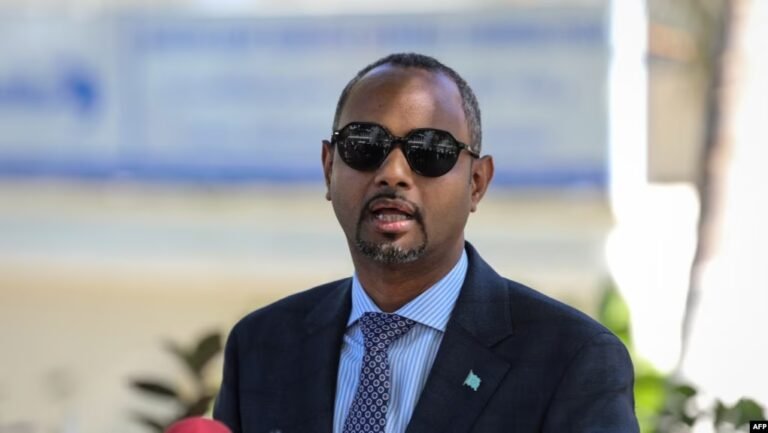
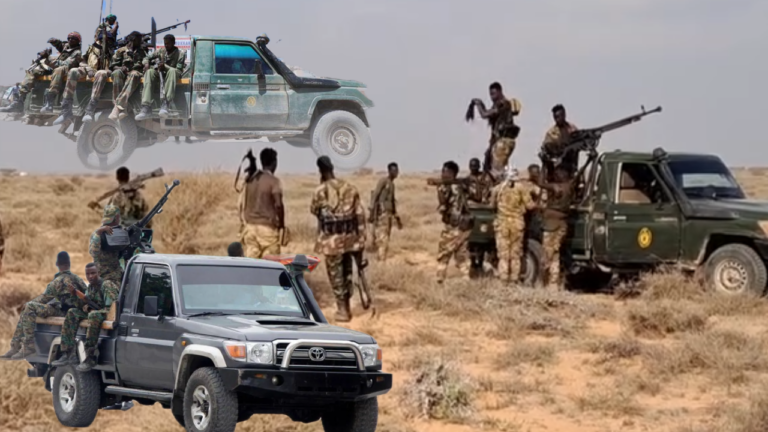
Sunday 16, March 2025 {HMC} The Somali National Army (SNA), in coordination with the U.S. military’s Africa Command (AFRICOM), conducted an airstrike targeting Al-Shabaab militants in the Middle Shabelle region of Hirshabelle State.
According to an SNA statement on Sunday, the strike hit the Laba Garas area and targeted an Al-Shabaab operative who was attempting to regroup following the group’s recent battlefield losses against Somali and allied local forces.
The SNA emphasized its ongoing collaboration with AFRICOM to weaken the militant group and assess its growing casualties. However, the statement did not disclose the number of militants killed in the latest operation.
The strike follows another recent operation in which at least 50 Al-Shabaab fighters, including a senior commander, were killed in airstrikes in the Damasha and Shabeelow areas of Middle Shabelle. Among the casualties was the group’s leader responsible for its combat vehicles.
The Somali government, with support from international partners, has intensified its military campaign against Al-Shabaab, targeting the group’s strongholds in central and southern Somalia.
Sunday 16, March 2025 {HMC} Yemen’s Ansar Allah, better known as the Houthis, has expanded cross-border collaboration with non-state actors in Somalia, namely the al-Qaeda-affiliated al-Shabab and the Islamic State in Somalia (ISS), which is associated with the Islamic State group that emerged in Iraq and Syria in 2014. While these groups diverge in ideology, ambition, and regional focus, they are united in their hostility to the United States and Israel, their pursuit of asymmetrical warfare, and their reliance on illicit economies. Such collaboration aims to strengthen and diversify supply chains, securing access to more sophisticated weaponry, improve the groups’ domestic standing, and increase the latitude of Ansar Allah and its main regional backer, Iran, to affect maritime security in the Gulf of Aden and Bab al-Mandab Strait to their advantage. This situation has heightened the sources of instability in the broader region.
Pragmatism Beyond Ideology
Much of the African Horn, especially the Red Sea littoral states, is integral to Yemen’s strategic depth due to its geographical proximity and long coastline. These factors have shaped historical patterns of migration, trade exchanges, cultural influence, and religious and social interactions. Yemen’s establishment of the Sanaa Cooperation Forum in 2003, which among other things addressed peace in Somalia, its mediation in the Somali crisis of 2006–2007, and its hosting of large numbers of displaced Somalis have underscored Yemeni preoccupation with the African country. Yemen has also been the African Horn’s gateway to the Gulf states, especially Saudi Arabia, including during periods of instability and conflict. The International Organization for Migration reported that 96,670 people crossed the Gulf of Aden into Yemen in 2023 thanks to human trafficking networks, especially from Somalia’s Bari and Woqooyi Galbeed regions.
The arms trade in the Red Sea has been a leading factor in Ansar Allah’s ties with Somalia. Despite a United Nations arms embargo on Yemen, Iran has supplied weapons surreptitiously to Ansar Allah. Between September 2015 and January 2023, warships from the United States, Saudi Arabia, France, and Australia intercepted sixteen vessels, carrying approximately 29,000 small arms and light weapons, 365 anti-tank guided missiles, and 2.38 million rounds of ammunition bound for Ansar Allah. Most of the consignments were transported on dhows used for coastal trade and fishing. In 2020, the Global Initiative Against Transnational Organized Crime concluded that a portion of Iranian-supplied arms to Ansar Allah ended up in Somalia.
While Iran’s dealings with African Horn countries have been characterized by ups and downs, Iran’s Islamic Revolutionary Guard Corps (IRGC) prioritized the region after 1989, later intensifying its efforts in the first decade of the twenty-first century. In 1989, Iran backed Sudanese president Omar al-Bashir’s rise; in 2006, it transferred weapons to the Islamic Courts Union so it could fight Somalia’s government; and in 2008 it sought a military presence in Eritrea, allowing it to use the Dahlak islands to send arms to Ansar Allah. In this way Tehran tried to break its international isolation, expand regional partnerships, and introduce supply mechanisms for its proxies, expanding its strategic reach.
Ansar Allah’s relationship with Somali nonstate actors, all of them under arms embargo, has evolved over the past decade through arms traffickers or brokers. This became increasingly important starting in 2016, when Ansar Allah realized it could strengthen its position by having a capacity to act in Yemen’s maritime space, whether by attacking vessels or engaging in smuggling—a lesson it applied during the Red Sea crisis over Gaza that began in October 2023. Ansar Allah’s leader, Abdul-Malik al-Houthi, again expressed this view in January 2025, when he cited the group’s maritime operations on Gaza’s behalf, while supporting developments in “several African countries … against American and European hegemony, and American imperialism and occupation [there].” This signaled his interest in broadening Ansar Allah’s activities into Africa.
In June 2024, the United States reported on collaboration between al-Shabab and Ansar Allah. A United Nations report from February 2025 revealed that representatives of the two groups had met at least twice in July and September 2024 in Somalia, underscoring Ansar Allah’s commitment to deepening ties during the Red Sea crisis. Under the reported deal, Ansar Allah would provide al-Shabab with arms and technical expertise in exchange for ramping up piracy attacks and collecting ransoms in the Gulf of Aden and off Somalia’s coast.1 Considering al-Shabab’s cooperation with Somali pirates, in which the former reportedly receives a 20 percent share of ransoms, the Ansar Allah–al-Shabab partnership likely involved using pirates to maximize maritime disruptions.2 The United States’ fear is that Ansar Allah’s weapons deliveries could provide it with a new financing stream, while giving al-Shabab access to more sophisticated arms.
Iran also has longstanding contacts with al-Shabab. In 2017, the IRGC’s Quds Force allowed the group to circumvent United Nations sanctions by using Iranian ports as transshipment points to reexport charcoal, generating revenues. Iran has also reportedly armed and funded al-Shabab to target U.S. interests in the African Horn, including Kenya. While tangible evidence that Iran has played a role in facilitating Ansar Allah’s ties with al-Shabab is required, U.S. intelligence officials are investigating such a possibility. Guled Ahmed, a Somali scholar at the Middle East Institute, is more affirmative, saying, “Iran is at the epicenter of all of this.”3 Moreover, al-Qaeda’s de facto leader Seif al-Adl is allegedly being hosted by Tehran and views convergence between Sunni and Shia militants as necessary to focus on fighting Western countries.
Ansar Allah’s relationship with ISS, in turn, has evolved since at least 2021.4 The relationship initially focused on the transfer of small arms. Between 2015 and 2022, U.S.-designated ISS members Abdirahman Mohamed Omar and Isse Mohamoud Yusuf smuggled arms from Yemen, suggesting preexisting connections with Ansar Allah. This was driven both by the domestic needs of ISS, which operates in Somalia’s Puntland region, and Ansar Allah’s desire to bolster its revenues, especially after the lull in the Yemen conflict starting in April 2022. When the Gaza war began in October 2023, Ansar Allah sought to increase international pressure for a ceasefire by interdicting maritime traffic in the Gulf of Aden and Red Sea. Between November 2023 and May 2024, it reportedly sent representatives to northeastern Somalia to coordinate intelligence gathering and the geolocation of ships in the Gulf of Aden, filling blind spots in its radar coverage, in exchange for short-range suicide drones and technical training.5 The Somali Puntland Security Force (PSF) seized five such drones dispatched by Ansar Allah in August 2024, arrested seven individuals suspected of having links to ISS and al-Shabab, and in January of this year ISS claimed two drone attacks against the PSF. Ansar Allah’s relationship with ISS and the latter’s access to arms smuggling networks follow on from Ansar Allah’s ties with al-Shabab and the fact that in 2015, ISS leader Abdul Qadir Mumin formed ISS with defectors from al-Shabab, which he opposes.
While Ansar Allah is a Jarudi Zaydi Shiite group, it has behaved pragmatically in dealing with Sunni jihadi groups, as shown by its collaboration with al-Qaeda in the Arabian Peninsula (AQAP). This relationship has involved the transfer of weapons to AQAP, the mutual provision of havens for each other’s members, and exchanges of prisoners, demonstrating that connections with al-Shabab and ISS are equally possible.
Expanding Sources of Instability Across the Gulf of Aden
The ramifications of Ansar Allah’s deepening collaboration with al-Shabab and ISS are multifaceted and critical to global maritime trade, peace, and security. The parties have common interests, all of which are reshaping security dynamics in the African Horn, the southern Red Sea, and the Gulf of Aden, adding to the potential theaters of instability and complicating arms interdiction efforts. These dynamics have also increased Ansar Allah’s geopolitical footprint, from which Iran has benefited, giving both parties leverage over a major international sea-lane.
A primary interest of Ansar Allah, al-Shabab, and ISS is their exploitation of illicit networks, particularly arms and fuel trafficking networks from Iran. Iran, in turn, sees these groups as helping it to diversify access to financing channels, smuggling routes, and offshore support bases. Such activities have increased the three groups’ sources of revenues and operational capabilities.6 Specifically, Ansar Allah’s collaboration with Somali non-state actors has facilitated the flow of Iranian weapons and resources to and from Yemen, circumventing the United Nations arms embargo. Weapons transfers often follow a roundabout route. Larger ocean-faring ships leave Iran and travel into Kenyan or Tanzanian waters to avoid detection by international naval forces near the Gulf of Aden, before heading toward Somalia. Then, smaller boats departing from Somalia, using falsified documents, smuggle arms into Yemen, particularly through Ras al-Aara in Lahj Governorate.7 Arms dealers and brokers have also sought to transfer surface-to-air missile systems from Eastern Europe to Ansar Allah via Somalia.8
Somali non-state actors view Ansar Allah’s possession of disruptive conventional weapons and drone capabilities as an encouraging game-changing development.9 For Ansar Allah, in turn, the transfer of weaponry and training is part of a package that has increased the group’s revenues, expanded its influence, secured logistical assistance, and allowed Ansar Allah’s elevation in the Axis of Resistance. The IRGC, which is keen to undercut Western interests, seeks to counterbalance rivals such as the United States, the Gulf states, and Türkiye, and expand its reach into the African Horn. It “oversees the strategic direction of this transactional cooperation, with Ansar Allah acting as a sub-regional coordinator given its operational resilience during the Red Sea crisis and geographical proximity,” according to Yazeed al-Jeddawy of the Sana’a Center for Strategic Studies.10 The Quds Force, a member of which sits on Ansar Allah’s Jihad Council, the group’s highest executive body, supervises the weapons transfers.
For Ansar Allah, Somalia’s porous coastlines have become critical to ensuring that the group has access to Iranian supplies and Chinese equipment necessary for the growth of its Iranian-supported drone and missile program.11 Much equipment to Ansar Allah enters through Somalia and Djibouti. Smuggling routes to Yemen include the coastline around the ports of Hodeida, Salif, Ras Issa, and Mocha in Taiz Governorate, al-Shihr and Mukalla in Hadramawt Governorate, Balhalf and Bir Ali in Shabwa Governorate, Nashtun and Sayhut in Mahra Governorate, and, on the Somali side, the Bosaso port in Puntland and the coasts of Burua, Hobyo, Baraawe, Merca, and Qandala, as well as the Barbera port in Somaliland. To supply Ansar Allah, the IRGC relies on Somali piracy networks, al-Shabab, and arms dealers in Yemen and Somalia. Among those coordinating Ansar Allah’s operations in Somalia are Abu Mohammed al-Murtadha and Abu Ibrahim al-Hadi, who not only oversee trafficking deals but also the expansion of cooperation with the Quds Force.12
Second, Ansar Allah’s collaboration with al-Shabab and ISS has indirectly given Iran an opportunity to develop its strategic depth in Somalia and the African Horn and widen its latitude to shape the maritime security architecture in the Gulf of Aden and Bab al-Mandab Strait. During the Gaza conflict, this gave Iran significant leverage over the transportation of hydrocarbons and other goods into the Mediterranean and Europe. An October 2024 report by the UN Panel of Experts on Yemen indicated that Ansar Allah was “evaluating options to carry out attacks at sea from the Somali coast,” having transferred drones and missiles to Somalia. These attacks did not materialize, chiefly because Iran suffered setbacks in its conflict with Israel between July and December 2024, and feared this would lead to more sustained attacks against Iranian territory.
Ansar Allah’s ties with al-Shabab and ISS have also allowed the parties to diversify their tools of access to Somalia’s maritime areas, while creating deniability for their partners. For example, in November 2023, Ansar Allah’s Abdul-Malek al-Aajri claimed that his group had seized a vessel, the Central Park, when in fact it was Somali pirates who had done so in coordination with Ansar Allah, demonstrating their joint influence. Therefore, maritime attacks are increasingly involving multiple actors across the Gulf of Aden, giving Iran and Ansar Allah the means to disrupt Red Sea trade when advantageous.
Ansar Allah’s connections with groups in Somalia have also allowed it to receive information from the other side of the Gulf of Aden in order to strike ships. During the Gaza conflict, Ansar Allah persuaded al-Shabab, ISS, and Somali pirates to attack vessels and block their passage into the Red Sea in solidarity with the Palestinians. An October 2024 UN Panel of Experts on Yemen report concluded that a third of Ansar Allah’s attacks occurred in areas of the Gulf of Aden outside the group’s radar coverage, “suggesting that the Houthis received external assistance in identifying, locating and targeting the vessels.” Such information was probably provided by the IRGC’s spy ship MV Behshad, Russia, al-Shabab, ISS, pirates, or other Somali groups.
In March 2024, Abdul-Malik al-Houthi confidently expressed his intention to expand maritime operations toward the Indian Ocean and Cape of Good Hope, tacitly indicating the possibility of using other countries’ territory to organize direct or proxy attacks. The uptick in Somali piracy during Israel’s offensive in Gaza, alongside Ansar Allah’s disruption of Red Sea maritime traffic, was probably no coincidence, corroborating reports of a partnership between Ansar Allah and al-Shabab.
A third factor behind the collaboration of Ansar Allah, al-Shabab, and ISS, is their shared desire to broaden the front against the United States, Israel, and those African countries supporting the Americans, which they regard as rivals or enemies. The transfer of drones and surface-to-air missiles to al-Shabab, and suicide drones to ISS, has improved the asymmetrical warfare capacity of both groups. This has increased threat perceptions in Ethiopia, Somalia, Djibouti, and Kenya (whose border region with Somalia is unstable), while increasing the groups’ ability to target regional security forces, including those from the Somali National Army, the African Union Transition Mission in Somalia, and U.S. Africa Command. The proliferation of drones has also created an environment in which Western resources may have to be reallocated elsewhere, with Ansar Allah likely hoping this may ease pressure on the group.
There are also domestic motivations for why Ansar Allah has deepened its relations with al-Shabab and ISS, posing potential risks for regional stability. Ansar Allah hopes to see its improved capabilities, networks, and resources in Somalia reflect positively on the trajectories of AQAP and the Islamic State in Yemen against Ansar Allah’s adversaries. Its goal is to increase Sunni jihadi actions in Yemen, which would fuel instability in government-held areas, discrediting the Yemeni government both internally and internationally and deepening mistrust within the government camp.
Ansar Allah appears to be succeeding in this strategy. The UN recently issued a report indicating that al-Shabab “reportedly sent over a dozen operatives to AQAP to acquire operational expertise and knowledge including in unmanned aerial vehicle technology,”13 underscoring the potential for spillover. Given such convergence, AQAP has been increasingly focused on targeting Western interests and forces aligned with Yemen’s government and the Southern Transitional Council, especially since 2021. This encompassed employing booby-trapped drones in 2023. Like al-Shabab and ISS, Ansar Allah and AQAP view the Yemeni government as “pro-Western,” and during the Gaza war AQAP’s resolve to deepen its collaboration with Ansar Allah only increased. As for Iran, the weakening of central governments in Yemen and Somalia has created a vacuum allowing it to expand its leeway to intervene and pursue Tehran’s interests across the Gulf of Aden. This was especially important after the Iran-dominated Axis of Resistance was substantially weakened in the conflict with Israel between October 2023 and December 2024, raising Ansar Allah’s value in the axis and in Iran’s calculations.
Conclusion
The expansion of Ansar Allah’s relationships with Somali non-state actors resonates with Iranian foreign policy objectives in the African Horn. Iran, whose Foreign Ministry spokesperson, Nasser Kanani, has described Africa as a “continent of opportunities,” has been revising its African Horn strategy in recent years, restoring diplomatic ties with Sudan, Djibouti, and Somalia in 2023–2024. Ansar Allah’s footprint in Somalia is a symptom of Iran’s engagement in the African Horn. Furthermore, Ansar Allah’s focus on regional smuggling networks is expected to increase now that the United States again designated the group as a foreign terrorist organization in February 2025 and imposed sanctions on seven of its leaders implicated in smuggling and arms procurement.
The IRGC, mindful of the strategic implications Ansar Allah’s actions have had on global maritime trade and security, has been reinforced in its belief in the importance of having sway in the Gulf of Aden, the Indian Ocean, and toward the Cape of Good Hope. As Iran aims to project power throughout the region and beyond, its aim is to be able to have an impact on maritime developments far from its shores. Polarization, conflict, poverty, fragmentation, and corruption will remain enabling conditions for such an ambition in the medium term. But whether the contrary ideological objectives of Sunni and Shiite jihadi groups will end up dividing the Iranians and Ansar Allah from al-Shabab and ISS, despite their shared anti-Western militancy, remains to be seen.
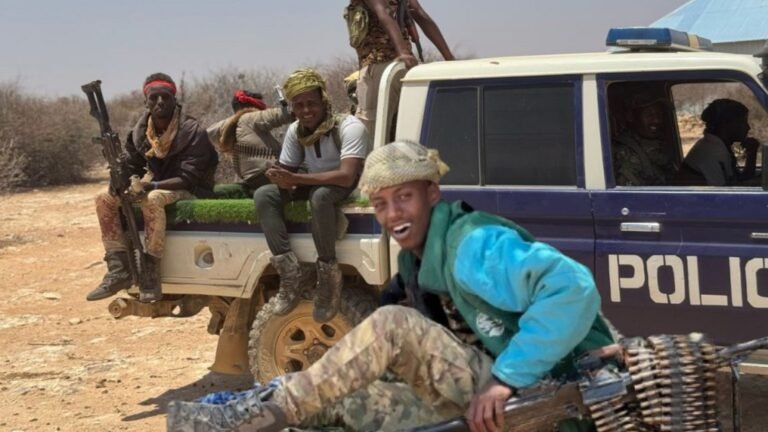
Sunday 16, March 2025 {HMC} The Galmudug Presidential Guard, the National Intelligence and Security Agency (NISA), Danab Special Forces, and the Somali Police carried out a coordinated clearance operation toda- targeting Al-Shabaab militants in areas near Ceel Garas in Galgaduud region.
The forces swept through the villages of Bulacle, Taragaduud, Xirsi-fiin, and Miirdugul, aiming to secure the areas between Ceel-Garas and Dhuusamareeb. Commanding officers informed the National Media that the operation was part of ongoing efforts to eliminate militant presence in the region.

Sunday 16, March 2025 {HMC} The Minister of Foreign Affairs and International Cooperation of the Federal Government of Somalia, H.E Ahmed Moallim Fiqi Ahmed, received the Ambassador of the People’s Republic of China to Somalia, H.E. Wang Yi, and discussed with him ways to strengthen bilateral relations and expand areas of joint cooperation.
The meeting addressed deepening cooperation in key sectors of mutual benefit, underscoring the long-standing partnership between the two friendly countries and highlighting opportunities to further enhance bilateral relations.
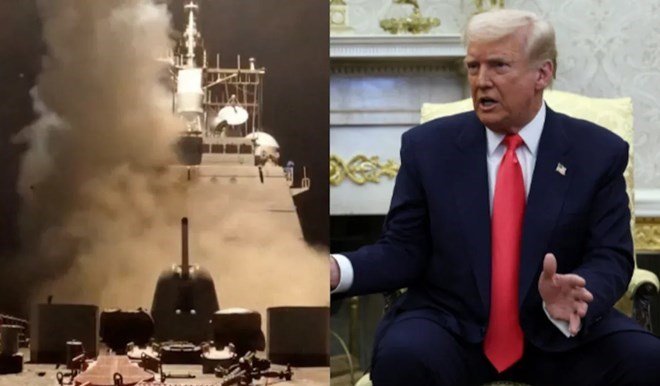
Sunday 16, March 2025 {HMC} President Donald Trump said he ordered a series of airstrikes on the Houthi-held areas in Yemen on Saturday, promising to use “overwhelming lethal force” until Iranian-backed Houthi rebels cease their attacks on shipping along a vital maritime corridor. The Houthis said at least 18 civilians were killed.
“Our brave Warfighters are right now carrying out aerial attacks on the terrorists’ bases, leaders, and missile defenses to protect American shipping, air, and naval assets, and to restore Navigational Freedom,” Trump said in a social media post. “No terrorist force will stop American commercial and naval vessels from freely sailing the Waterways of the World.”
He also warned Iran to stop supporting the rebel group, promising to hold the country “fully accountable” for the actions of its proxy. It comes two weeks after the U.S. leader sent a letter to Iranian leaders offering a path to restarting bilateral talks between the countries on Iran’s advancing nuclear program. Trump has said he will not allow it to become operational.
The Houthis reported explosions in their territory Saturday evening, in the capital of Sanaa and the northern province of Saada, the rebels’ stronghold on the border with Saudi Arabia, with more airstrikes reported in those areas early Sunday. Images online showed plumes of black smoke over the area of the Sanaa airport complex, which includes a sprawling military facility. The Houthis also reported airstrikes early Sunday on the provinces of Hodeida, Bayda, and Marib.
At least 18 people were killed, including 13 in Sanaa and five in Saada, according to the Houthi-run health ministry. At least 24 others were wounded, including nine in Sanaa and 15 in Saada, it said.
A U.S. official said this was the beginning of air strikes on Houthi targets that are expected to continue. The official spoke on the condition of anonymity because they were not authorized to talk to the press.
Nasruddin Amer, deputy head of the Houthi media office, said the airstrikes won’t deter them and they would retaliate against the U.S. “Sanaa will remain Gaza’s shield and support and will not abandon it no matter the challenges,” he added on social media.
Another spokesman, Mohamed Abdulsalam, on X, called Trump’s claims that the Houthis threaten international shipping routes “false and misleading.”
The airstrikes come a few days after the Houthis said they would resume attacks on Israeli vessels sailing off Yemen in response to Israel’s latest blockade on Gaza. They described the warning as affecting the Red Sea, the Gulf of Aden, the Bab el-Mandeb Strait and the Arabian Sea.
There have been no Houthi attacks reported since then.
Earlier this month, Israel halted all aid coming into Gaza and warned of “additional consequences” for Hamas if their fragile ceasefire in the war isn’t extended as negotiations continue over starting a second phase.
The Houthis had targeted over 100 merchant vessels with missiles and drones, sinking two vessels and killing four sailors, during their campaign targeting military and civilian ships between the start of the war between Israel and Hamas in late 2023 and January of this year, when this ceasefire in Gaza took effect.
The attacks raised the Houthis’ profile as they faced economic and other problems at home amid Yemen’s decade-long stalemated war that’s torn apart the Arab world’s poorest nation.
The Houthi media office said the U.S. strikes hit a residential neighborhood in Sanaa’s northern district of Shouab. Residents said at least four airstrikes rocked the Eastern Geraf neighborhood there, terrifying women and children.
“The explosions were very strong,” said Abdallah al-Alffi. “It was like an earthquake.”
The Eastern Geraf is home to Houthi-held military facilities and a headquarters for the rebels’ political bureau, located in a densely populated area.
The Houthis reported fresh strikes on the southwestern Dhamar province late Saturday. They said the strikes hit the outskirts of the provincial capital, also named Dhamar, and the district of Abs.
The United States, Israel and Britain have previously hit Houthi-held areas in Yemen. Israel’s military declined to comment.
However, Saturday’s operation was conducted solely by the U.S., according to a U.S. official. It was the first strike on the Yemen-based Houthis under the second Trump administration.
Such broad-based missile strikes against the Houthis were carried out multiple times by the Biden administration in response to frequent attacks by the Houthis against commercial and military vessels in the region.
The USS Harry S. Truman carrier strike group, which includes the carrier, three Navy destroyers and one cruiser, are in the Red Sea and were part of Saturday’s mission. The USS Georgia cruise missile submarine has also been operating in the region.
Trump announced the strikes as he spent the day at his Trump International Golf Club in West Palm Beach, Florida.
“These relentless assaults have cost the U.S. and World Economy many BILLIONS of Dollars while, at the same time, putting innocent lives at risk,” Trump said.

By MICHELLE L. PRICE, LOLITA C. BALDOR and SAMY MAGDY
Axad 16, March 2025 {HMC} Dhageystayaal halkan waxa aan idiin kugu soo gudbi neynaa Warka Habeenimo ee Warbaahinta Hiiraanweyn
Warka waxaa soo jeedinayo ::Abdiqani Osoble
Farsamadii ::Mohamed Baryare Haamud
Axad 16,March 2025 {HMC} Waxaa halkan idin kugu soo gudbineyna Dhacdooyinkii Ugu Dambeeyay Caalamka ee Warbaahinta Hiiraanweyn.