


Saturday December 13, 2025 {HMC} A 20-year-old Somali American citizen was tackled, put in a chokehold and detained for about two hours by masked federal immigration agents in Minneapolis, an incident city leaders say illustrates how U.S. Immigration and Customs Enforcement is targeting people who “look Somali” as part of a wider crackdown.
The man, who asked to be identified only as Mubashir for safety reasons, was not charged with a crime. He says agents refused to review his passport information, denied him water and medical care and released him only after he was finally allowed to show a digital copy of his ID at the Bishop Henry Whipple Federal Building at Fort Snelling.
advertisements
Mayor Jacob Frey and Police Chief Brian O’Hara are condemning the arrest, which was captured on security and bystander video in the city’s Cedar-Riverside neighborhood. They say the case raises civil liberties concerns as federal authorities carry out “Operation Metro Surge,” an immigration enforcement push in the Twin Cities launched Dec. 1 that the U.S. Department of Homeland Security says has resulted in more than 400 arrests in Minnesota and several other cities.
“You can’t tackle somebody because they look Somali without knowing who they are, what their name is,” Frey said after watching the footage at City Hall. “You can’t then detain them for purposes of immigration when they’re a completely legal American citizen.”
DHS defends agents, rejects profiling claims
In a written statement, DHS said immigration officers were investigating suspected immigration violations in an area with “a high level of criminal activity” when Mubashir walked out of a nearby restaurant, turned around and fled from law enforcement.
The agency said agents had “reasonable suspicion” to pursue him, claimed he “violently resisted” and said a “large crowd of agitators” forced them to detain him temporarily in order to finish asking questions.
DHS rejected accusations of racial profiling as “disgusting, reckless, and categorically FALSE” and said agents are trained to use reasonable suspicion and standard interview methods to determine immigration status. “What makes someone a target for immigration enforcement is if they are illegally in the U.S. — NOT their skin color, race, or ethnicity,” the statement said.
Mubashir flatly disputes that account. He says he briefly turned when he saw a vehicle pull up, then stopped and stood still before a masked agent ran toward him “at full speed.”
Security video from a nearby building shows agents pushing him through a rear doorway and pinning him against a metal gate as they ask, “Why are you running?” Bystander video shows one agent wrapping an arm around his neck as he kneels in the snow before the officers force him into the back of a gray, unmarked SUV while people nearby shout that he is a citizen.
“I told him, ‘I’m a U.S. citizen. What is going on?’” Mubashir said at a news conference. “I felt like I was getting assaulted, like I was getting kidnapped. If this is what’s happening to a U.S. citizen on camera, imagine what could happen when there’s no one around.”
O’Hara apologized to Mubashir “for what happened to you in my city, with people wearing vests that say ‘police.’” The chief said he does not object to lawful, well-planned arrests, but called some recent federal actions “questionable” and “unplanned,” saying they put both officers and residents at risk.
Enforcement surge and Trump rhetoric fuel fear
Operation Metro Surge is a Twin Cities–based enforcement effort that DHS says targets people with criminal records or outstanding deportation orders. Officials describe those arrested as “some of the worst of the worst criminal illegal aliens” and say the operation is focused on public safety threats.
Community advocates and local officials say that is not what they are seeing. They report agents stopping people on sidewalks, at workplaces and in shopping centers — including U.S. citizens — based largely on appearance and location, with Somali and Latino neighborhoods bearing the brunt of the surge.
The enforcement push is unfolding amid increasingly harsh language from President Donald Trump about Somalis and other immigrants.
At a rally in Pennsylvania this week, Trump revisited a 2018 White House discussion in which he referred to Haiti, El Salvador and African nations as “s—hole countries,” a remark he once denied. “We always take people from Somalia,” he told supporters. “Places that are a disaster. Filthy, dirty, disgusting, ridden with crime.”
Days earlier, he referred to Somalis as “garbage” during a cabinet meeting, according to Somali and international officials, and vowed to “permanently pause” migration from what he calls “hellhole” and “Third World” countries.
The White House and DHS say the crackdown is about crime and border security, not race. Critics say the effect is that an entire community — including U.S. citizens and legal residents — is treated as suspect.
“People who have lived here for decades are carrying passports to go to the grocery store,” said Minnesota state Sen. Zaynab Mohamed, a Somali American. “Somalis are the scapegoat.”
Somali and Latino neighborhoods pull back
Minnesota has the largest Somali population in the United States, with about 100,000 people of Somali descent. Most are U.S. citizens or lawful permanent residents.
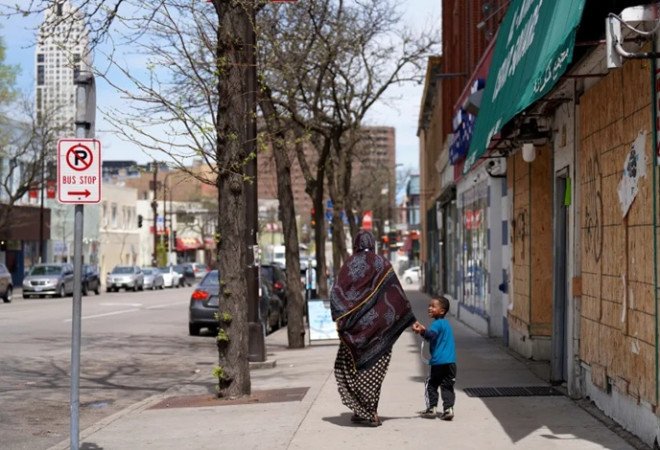
In Minneapolis, Somali neighborhoods that used to buzz at midday now feel noticeably quieter. At Karmel Mall, an indoor market favored by Somali families, vendors say many stalls selling food, clothing, rugs and jewelry have stayed closed since the surge began. Signs on the doors warn that ICE cannot enter without a court order. Volunteer “block watchers” stand outside with whistles and phones, ready to send alerts if they see agents nearby.
“People don’t want to deal with ICE agents coming into their businesses and violating their rights,” Mohamed said.
Latino business districts have also suffered. On Lake Street, where Latino and Somali shops line the corridor, some stalls are dark because employees were detained, owners say. Customers are staying home rather than risk being stopped on sidewalks or in parking lots.
“They are snatching people from the streets,” said Daniel Hernandez, who runs a market and restaurant on East Lake Street. “They’re fearful because they are Latinos and Somalis being targeted.”
Hernandez and other grocers in Minneapolis and St. Paul have started delivering groceries to customers who are too afraid to shop in person. One St. Paul supermarket owner said he now makes dozens of deliveries a day.
Community leaders say the chill has spread into mosques and clinics. Attendance at Friday prayers has dropped. A nurse practitioner in south Minneapolis said patients have canceled medical appointments rather than drive through areas where they have seen federal agents. Some health workers are offering telehealth visits and home calls to reach those who stay inside.
Overhead, residents have noticed helicopters circling the city. Customs and Border Protection confirmed that its aircraft are “supporting federal law enforcement partners in Minneapolis,” but did not say how they are being used. Advocacy groups worry about aerial surveillance and say the flights add to a feeling of being watched.
Students carry passports and track each other
The anxiety is not limited to business districts and apartment buildings. Somali American students on Twin Cities campuses say they have changed their daily routines as immigration agents move through the metro.
At the University of Minnesota, a freshman who asked to be identified only by her nickname, Cho, now slips a passport card into her wallet every morning before commuting from her family’s home. She and her five siblings, all U.S.-born citizens, share their locations in a group chat throughout the day.
“Honestly, it’s really scary,” she said. “I’m afraid to participate in everyday activities, hang out with friends or anything. Even going to work, just driving, is anxious, because it’s that constant fear of being stopped and harassed.”
At Augsburg University, where many students are Somali American, school officials have tightened building access and encouraged professors to be flexible with coursework. Iman, an Augsburg freshman and U.S. citizen who also asked to use only her first name, says she never leaves campus without identification now.
“There is this stereotype now because of the fraud case that we all do fraud,” she said. “A lot of us worked hard for where we are. My parents started from the bottom.”
The American Civil Liberties Union of Minnesota says it has heard of at least a dozen U.S. citizens of Somali descent being detained in recent ICE operations. Staff attorney Ian Bratlie calls that pattern “unlawful racial profiling” and urges people to know their rights, keep documents accessible and record encounters with officers when it is safe.
“There may be situations where the university is going to protect itself first,” he said. “People should be prepared to protect themselves as well.”
Pushback from unions, Minnesota officials and Mogadishu
Opposition to the crackdown has spread from Minneapolis streets to union halls, state government and officials in Somalia.
At Minneapolis–St. Paul International Airport, unions held a demonstration denouncing Trump’s threats against Somalis and criticizing the airport commission and airlines for cooperating with deportation flights. “In the labor movement, an injury to one is an injury to all,” said Minnesota AFL-CIO President Bernie Burnham. “By vilifying our Somali American co-workers and neighbors, President Trump is attacking our state’s entire labor movement.”
In Rochester, about 85 miles southeast of Minneapolis, faith leaders and local officials gathered under the banner “WE ARE HOME AND HERE TO STAY.” They shared potluck food and told stories of Somali parents working long shifts in factories and hospitals so their children could attend college.
“If Minnesota winters could not bully us, no politicians with a microphone can,” community leader Saleh Mohamed told the crowd.
Minnesota Gov. Tim Walz has asked Homeland Security Secretary Kristi Noem to review the arrests of Mubashir and other citizens and to place any agent who acted unlawfully on leave. “The forcefulness, lack of communication, and unlawful practices displayed by your agents will not be tolerated in Minnesota,” Walz wrote in a letter.
In Mogadishu, Somalia’s defense minister, Ahmed Moallim Fiqi, rejected Trump’s remarks about Somalis being “filthy” and “ridden with crime” and praised his country’s citizens for their resilience.
“The Somali people are known around the world for their hard work,” he said. While expressing gratitude for U.S. military support against al-Qaida-linked militants, he urged Trump to focus on keeping his promises to American voters instead of “busying himself with Somalia.”
‘This is my home’
For many Somali families in Minnesota, the past weeks have meant hard choices: whether to send children to school, attend mosque, keep a medical appointment or simply step outside.
Some have decided to stay home and keep their blinds closed. Others have signed up as neighborhood monitors, legal observers or volunteer drivers. Business owners are promoting “days of action” to draw customers back to Somali and other immigrant-owned shops and cafes that once felt safe.
“We encourage folks to patronize the businesses, to learn about the community,” said Jaylani Hussein, executive director of the Minnesota chapter of the Council on American-Islamic Relations. “This sends a strong message that our neighbors are going to come visit us, and that we’re not going to abandon one another.”
Mubashir, who came to the United States as a young child and later became a citizen, says he now looks over his shoulder every time he leaves his home.
“I’m scared to go outside,” he said. “We shouldn’t be targeted just because we’re Somalis.”
Asked whether he has thought about leaving Minneapolis, he did not hesitate.
“This is my home,” he said. “We’re not going anywhere.”
